

What Is the MCAT®? | Everything Pre-Med Students Need to Know

The MCAT, or Medical College Admission Test, is a standardized, computer-based exam developed and administered by the Association of American Medical Colleges® (AAMC®). Required for admission to virtually all allopathic (MD) and osteopathic (DO) medical schools in the United States and Canada.
A pre-med student researching MCAT exam details

The MCAT test evaluates the scientific knowledge, critical thinking, and reasoning skills that medical schools expect from incoming students. If you're wondering what is on the MCAT exam? Why does it matter? This guide covers everything from the MCAT format and MCAT exam length to scoring and registration.

What Does MCAT Stand For?

MCAT stands for Medical College Admission Test. The exam has existed in some form since 1928, making it one of the oldest standardized tests in the country. The current version, the format most students know today, was redesigned and launched in April 2015 to better reflect modern medical education, with an emphasis on applying knowledge rather than simple fact recall. The MCAT exam is administered exclusively through the AAMC and tested at Pearson VUE centers nationwide.

MCAT Exam Format: Sections, Questions, and Timing

The MCAT format consists of four multiple-choice sections administered in a fixed order. Here is the complete MCAT exam breakdown.

They are:

  1. Biological and Biochemical Foundations of Living Systems
  2. Chemical and Physical Foundations of Biological Systems
  3. Psychological, Social, and Biological Foundations of Behavior
  4. Critical Analysis and Reasoning Skills (CARS)
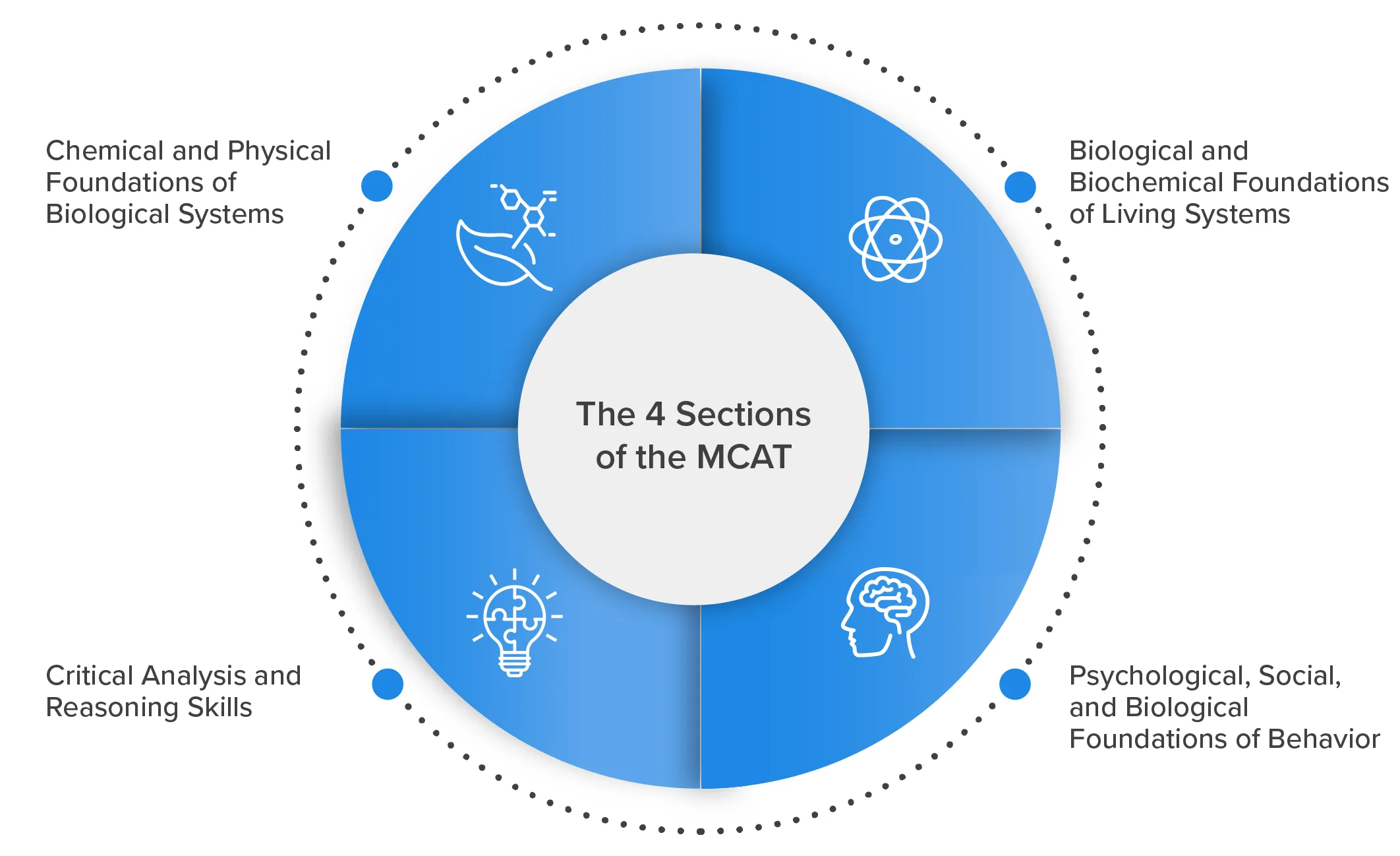
Infographic of the four MCAT sections

How Long Is the MCAT?

The total MCAT exam length from check-in to dismissal is approximately 7 hours and 30 minutes. The actual MCAT test duration (questions only) is 6 hours and 15 minutes. Each student is allotted one 30-minute mid-exam break and two 10-minute optional breaks. Unused breaks do not carry over to the next section. Each of the four exam sections is tested for 90 to 95 minutes, making the total testing time about 375 minutes (6.25 hours). The MCAT test length and MCAT exam duration have remained unchanged since the 2015 redesign.

How Many Questions Are on the MCAT?

There are 53 to 59 questions per MCAT section, coming in the form of passage-based and discrete (standalone) questions. Altogether, there are 230 questions on the MCAT. This makes building your test-taking endurance a vital piece of your exam preparation.
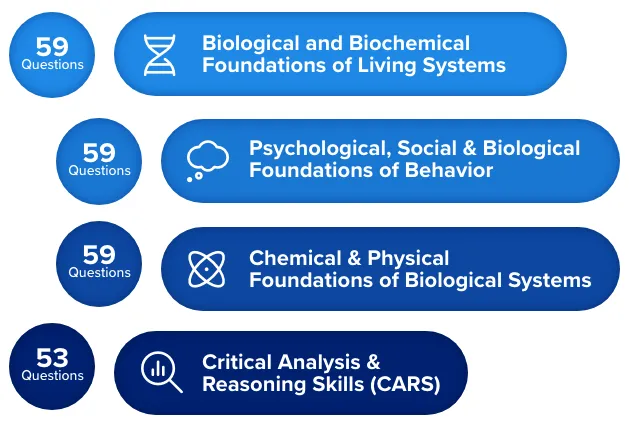
Infographic of the number of questions in each MCAT section

Why the MCAT Matters

A strong MCAT score is one of the most important components of a competitive medical school application. Nearly all U.S. medical schools and many Canadian programs use your MCAT test results to assess your readiness for the rigors of medical education. Medical schools consider the MCAT alongside your GPA, extracurriculars, personal statement, and interviews when making admissions decisions.

How Is the MCAT Scored?

Each of the four MCAT test sections is scored on a scale of 118 to 132, for a total score range of 472 to 528. The midpoint, a score of 500 represents average performance. Most competitive applicants applying to U.S. medical school programs aim for a 511 score or higher, which places them near or above the median for matriculants at many schools. Scores are released approximately 30 to 35 days after your exam date by 5 PM ET. For a detailed breakdown of what your score means and how medical schools evaluate it, see our MCAT scoring guide.

MCAT score range including what a good MCAT score is

MCAT Registration and Test Dates

You can register for the MCAT test through the official AAMC website. The MCAT is administered between January and September at certified testing centers. Early registration is recommended to secure your preferred date and location.

When Do You Take the MCAT?

MCAT test dates are updated each year, and you should register for the MCAT as soon as you know your preferred testing date. Most students take the MCAT in their junior or senior year of college after having completed introductory science, psychology, and sociology courses. Most students take the exam in the spring or summer one year before applying to medical school.

Give yourself 3–6 months to prepare. Most students score their best after 300+ hours of MCAT test prep.

How to Prepare for the MCAT

The most effective way to prepare for the MCAT is to follow a structured MCAT program over the course of 3 to 6 months. UWorld’s Comprehensive MCAT prep course is designed to be your all-in-one solution, featuring the full AAMC Prep Hub alongside thousands of MCAT-style questions, print and digital books, videos, flashcards, and smart performance tracking tools. Our course supports mastery of every topic recommended by the AAMC so you can feel fully prepared for every section of the MCAT exam.

Summary: Key MCAT Facts

Feature Details
Exam Name Medical College Admission Test (MCAT)
Administered By Association of American Medical Colleges (AAMC)
Sections 4 (BBLS, CPBS, PSBB, CARS)
Score Range 472–528
Test Duration 7.5 hours
Test Centers Administered at official AAMC testing locations
Registration On AAMC website
MCAT Prep Resources UWorld Comprehensive MCAT Prep Course (UWorld + AAMC Prep Hub)

Frequently Asked Questions

Yes, international students can take the MCAT; however, testing dates and locations are limited. Read more about the MCAT for international students.

The MCAT is one of the most difficult U.S. graduate school entrance exams. However, achieving a high score is manageable with advanced preparation and an effective study plan. Performing well on the MCAT shows medical schools that you have a good foundation and are more likely to succeed in medical school.

Top MCAT scorers begin their preparation early, usually 3 to 6 months or more before their exam, and typically allocate around 300 hours or more of dedicated study time.

Students can take the MCAT test 3 times in a calendar year, and 4 times within two calendar years. There is a lifetime limit of 7 attempts per person.

If your first MCAT score is low compared to the averages of the students accepted to your preferred medical schools, you should consider retaking the MCAT. AAMC data shows that most students obtain a higher score on their second attempt, especially if their first score was 517 or lower. If you are considering a retake, make sure you use a quality MCAT program that includes books, videos, practice exams, representative questions, and detailed analytics so you can track your progress.

More than 85,000 students take the MCAT each year, according to the AAMC. Not all test-takers apply to medical school in the same cycle, some take the exam before committing to an application.

Read More About the MCAT

MCAT Registration Guide

Learn about the MCAT registration and scheduling process, including suggested prerequisites, rescheduling information, and various costs and fees.

MCAT Sections

Explore the MCAT’s four key sections, understand the exam breakdown and format, and get the guidance you need to strategically plan your prep.

MCAT Scores, Percentiles, and Pass Rates

Take a deep dive into MCAT scoring to discover what you need to achieve your goals. We cover average scores, breakdowns by section, acceptance rates by score, and more.

MCAT Test Dates & Score Release Dates

View the latest MCAT testing calendar for your country, including registration deadlines and score release dates based on when you take the exam.

For International Students

Ready to take the MCAT as an international student? Learn everything you need to know about MCAT eligibility, registration, and tips for international students.
View More...
Scroll to Top

Try Our MCAT Course

FREE for 7 Days

See the Difference for Yourself
No credit card required
