Train With the Best
MCAT Questions
 
MCAT
QBank
Starting at $339
Buy Now
 
Core
Prep Course
Starting at $599
Buy Now
Best Value!
Comprehensive
Prep Course
Starting at $1,199
Buy Now
 
3,000+ MCAT-level Questions
Practice with MCAT-style questions and visual explanations.
New! 2 UWorld MCAT Practice Exams
Practice with two full length exams with new MCAT exam questions and visual explanations.
New! AI-Powered MCAT Tutor
Get tutor-like guidance with UAsk, an AI tutor that provides instant answers trained by our experts.
Adaptive Study Planner
Stay organized with a personalized study schedule.
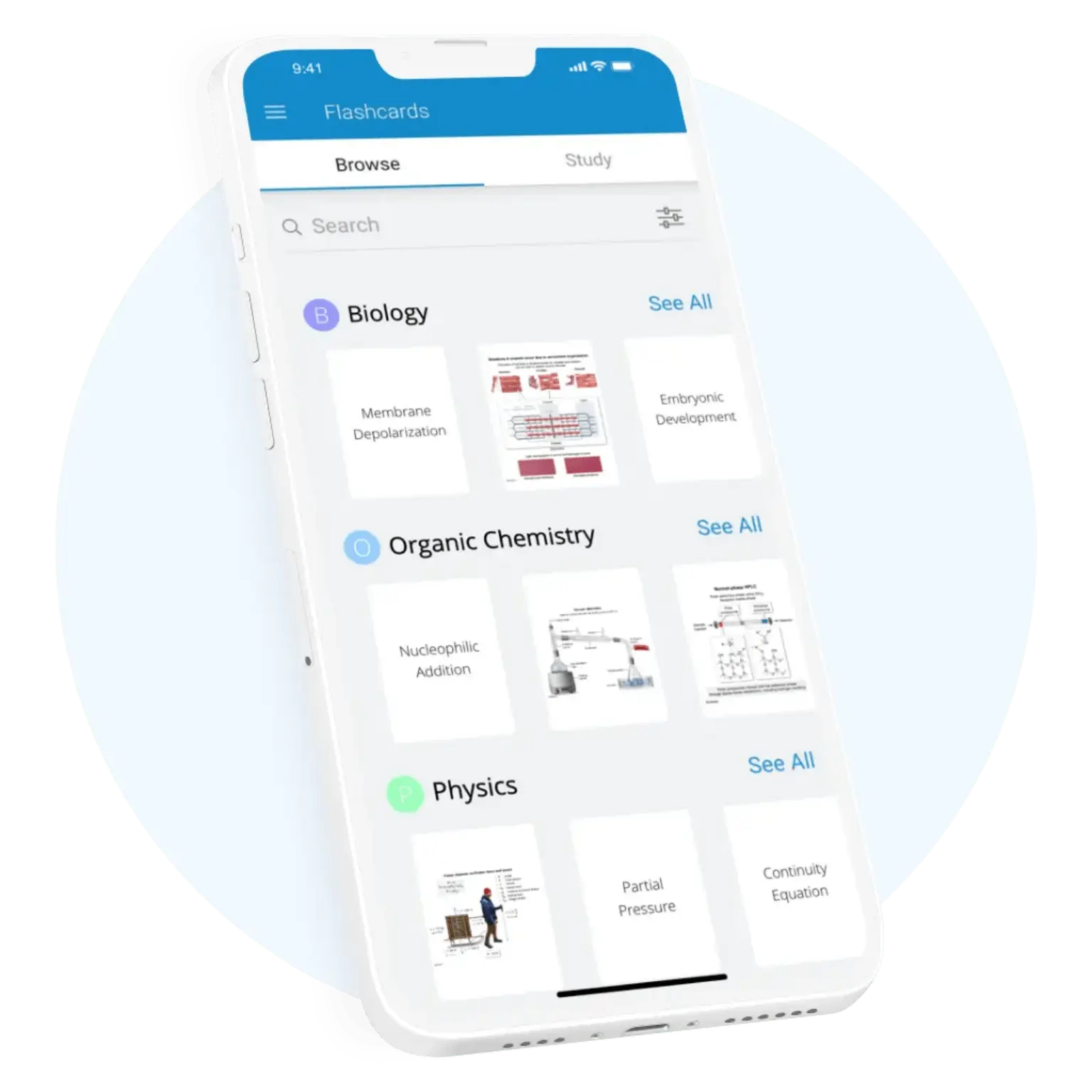
Flashcard Tool With Spaced-Repetition
Create your own flashcards from existing UWorld content.
Smart Study Tools
Review on the go with our digital notebook and mobile app.
Detailed Performance Analytics
Track your progress with detailed performance analytics.
6 Print and Digital Science Review Books
Study MCAT science content with print and digital review books.
2 Print and Digital CARS Review Books
Master MCAT CARS with print and digital review books.
450 Concept Check Questions
Test yourself with concept check questions featuring visual explanations.
1,300+ High-Yield Video Lessons
Understand key MCAT topics with engaging video lessons.
7 AAMC MCAT Practice Exams
Train like it’s test day with 7 AAMC practice exams.
AAMC® Prep Hub Resources ($390 Value)
Access all official AAMC MCAT section banks, question bank, and more!
4,000 Flashcard Quiz Questions
Reinforce learning with adaptive end-of-lesson quizzes.
Train With the Best MCAT Questions
MCAT QBank
Starting at $339
Buy Now
Core Prep Course
Starting at $599
Buy Now
Train With the Best
MCAT Questions
Best Value!
Comprehensive
Prep Course
Starting at $1,199
Buy Now
 
Core
Prep Course
Starting at $599
Buy Now
 
MCAT
QBank
Starting at $339
Buy Now
 
3,000+ MCAT-level Questions
Practice with MCAT-style questions and visual explanations.
New! 2 UWorld MCAT Practice Exams
Practice with two full length exams with new MCAT exam questions and visual explanations.
New! AI-Powered MCAT Tutor
Get tutor-like guidance with UAsk, an AI tutor that provides instant answers trained by our experts.
Adaptive Study Planner
Stay organized with a personalized study schedule.
Flashcard Tool With Spaced-Repetition
Create your own flashcards from existing UWorld content.
Smart Study Tools
Review on the go with our digital notebook and mobile app.
Detailed Performance Analytics
Track your progress with detailed performance analytics.
6 Print and Digital Science Review Books
Study MCAT science content with print and digital review books.
2 Print and Digital CARS Review Books
Master MCAT CARS with print and digital review books.
450 Concept Check Questions
Test yourself with concept check questions featuring visual explanations.
1,300+ High-Yield Video Lessons
Understand key MCAT topics with engaging video lessons.
7 AAMC MCAT Practice Exams
Train like it’s test day with 7 AAMC practice exams.
AAMC® Prep Hub Resources ($390 Value)
Access all official AAMC MCAT section banks, question bank, and more!
4,000 Flashcard Quiz Questions
Reinforce learning with adaptive end-of-lesson quizzes.
Train With the Best MCAT Questions
Core Prep Course
Starting at $599
Buy Now
MCAT QBank
Starting at $339
Buy Now
3,000+ MCAT-level Questions
Practice with MCAT-style questions and visual explanations.
New! 2 UWorld MCAT Practice Exams
Practice with two full length exams with new MCAT exam questions and visual explanations.
New! AI-Powered MCAT Tutor
Get tutor-like guidance with UAsk, an AI tutor that provides instant answers trained by our experts.
Adaptive Study Planner
Stay organized with a personalized study schedule.
Flashcard Tool With Spaced-Repetition
Create your own flashcards from existing UWorld content.
Smart Study Tools
Review on the go with our digital notebook and mobile app.
Detailed Performance Analytics
Track your progress with detailed performance analytics.
6 Print and Digital Science Review Books
Study MCAT science content with print and digital review books.
2 Print and Digital CARS Review Books
Master MCAT CARS with print and digital review books.
450 Concept Check Questions
Test yourself with concept check questions featuring visual explanations.
1,300+ High-Yield Video Lessons
Understand key MCAT topics with engaging video lessons.
7 AAMC MCAT Practice Exams
Train like it’s test day with 7 AAMC practice exams.
AAMC® Prep Hub Resources ($390 Value)
Access all official AAMC MCAT section banks, question bank, and more!
4,000 Flashcard Quiz Questions
Reinforce learning with adaptive end-of-lesson quizzes.
3,000+ MCAT-level Questions
Practice with MCAT-style questions and visual explanations.
New! 2 UWorld MCAT Practice Exams
Practice with two full length exams with new MCAT exam questions and visual explanations.
New! AI-Powered MCAT Tutor
Get tutor-like guidance with UAsk, an AI tutor that provides instant answers trained by our experts.
Adaptive Study Planner
Stay organized with a personalized study schedule.
Flashcard Tool With Spaced-Repetition
Create your own flashcards from existing UWorld content.
Smart Study Tools
Review on the go with our digital notebook and mobile app.
Detailed Performance Analytics
Track your progress with detailed performance analytics.
6 Print and Digital Science Review Books
Study MCAT science content with print and digital review books.
2 Print and Digital CARS Review Books
Master MCAT CARS with print and digital review books.
450 Concept Check Questions
Test yourself with concept check questions featuring visual explanations.
1,300+ High-Yield Video Lessons
Understand key MCAT topics with engaging video lessons.
7 AAMC MCAT Practice Exams
Train like it’s test day with 7 AAMC practice exams.
AAMC® Prep Hub Resources ($390 Value)
Access all official AAMC MCAT section banks, question bank, and more!
4,000 Flashcard Quiz Questions
Reinforce learning with adaptive end-of-lesson quizzes.
3,000+ MCAT-level Questions
Practice with MCAT-style questions and visual explanations.
New! 2 UWorld MCAT Practice Exams
Practice with two full length exams with new MCAT exam questions and visual explanations.
New! AI-Powered MCAT Tutor
Get tutor-like guidance with UAsk, an AI tutor that provides instant answers trained by our experts.
Adaptive Study Planner
Stay organized with a personalized study schedule.
Flashcard Tool With Spaced-Repetition
Create your own flashcards from existing UWorld content.
Smart Study Tools
Review on the go with our digital notebook and mobile app.
Detailed Performance Analytics
Track your progress with detailed performance analytics.
6 Print and Digital Science Review Books
Study MCAT science content with print and digital review books.
2 Print and Digital CARS Review Books
Master MCAT CARS with print and digital review books.
450 Concept Check Questions
Test yourself with concept check questions featuring visual explanations.
1,300+ High-Yield Video Lessons
Understand key MCAT topics with engaging video lessons.
7 AAMC MCAT Practice Exams
Train like it’s test day with 7 AAMC practice exams.
AAMC® Prep Hub Resources ($390 Value)
Access all official AAMC MCAT section banks, question bank, and more!
4,000 Flashcard Quiz Questions
Reinforce learning with adaptive end-of-lesson quizzes.
3,000+ MCAT-level Questions
Practice with MCAT-style questions and visual explanations.
New! 2 UWorld MCAT Practice Exams
Practice with two full length exams with new MCAT exam questions and visual explanations.
New! AI-Powered MCAT Tutor
Get tutor-like guidance with UAsk, an AI tutor that provides instant answers trained by our experts.
Adaptive Study Planner
Stay organized with a personalized study schedule.
Flashcard Tool With Spaced-Repetition
Create your own flashcards from existing UWorld content.
Smart Study Tools
Review on the go with our digital notebook and mobile app.
Detailed Performance Analytics
Track your progress with detailed performance analytics.
6 Print and Digital Science Review Books
Study MCAT science content with print and digital review books.
2 Print and Digital CARS Review Books
Master MCAT CARS with print and digital review books.
450 Concept Check Questions
Test yourself with concept check questions featuring visual explanations.
1,300+ High-Yield Video Lessons
Understand key MCAT topics with engaging video lessons.
7 AAMC MCAT Practice Exams
Train like it’s test day with 7 AAMC practice exams.
AAMC® Prep Hub Resources ($390 Value)
Access all official AAMC MCAT section banks, question bank, and more!
4,000 Flashcard Quiz Questions
Reinforce learning with adaptive end-of-lesson quizzes.
3,000+ MCAT-level Questions
Practice with MCAT-style questions and visual explanations.
New! 2 UWorld MCAT Practice Exams
Practice with two full length exams with new MCAT exam questions and visual explanations.
New! AI-Powered MCAT Tutor
Get tutor-like guidance with UAsk, an AI tutor that provides instant answers trained by our experts.
Adaptive Study Planner
Stay organized with a personalized study schedule.
Flashcard Tool With Spaced-Repetition
Create your own flashcards from existing UWorld content.
Smart Study Tools
Review on the go with our digital notebook and mobile app.
Detailed Performance Analytics
Track your progress with detailed performance analytics.
6 Print and Digital Science Review Books
Study MCAT science content with print and digital review books.
2 Print and Digital CARS Review Books
Master MCAT CARS with print and digital review books.
450 Concept Check Questions
Test yourself with concept check questions featuring visual explanations.
1,300+ High-Yield Video Lessons
Understand key MCAT topics with engaging video lessons.
7 AAMC MCAT Practice Exams
Train like it’s test day with 7 AAMC practice exams.
AAMC® Prep Hub Resources ($390 Value)
Access all official AAMC MCAT section banks, question bank, and more!
4,000 Flashcard Quiz Questions
Reinforce learning with adaptive end-of-lesson quizzes.
3,000+ MCAT-level Questions
Practice with MCAT-style questions and visual explanations.
New! 2 UWorld MCAT Practice Exams
Practice with two full length exams with new MCAT exam questions and visual explanations.
New! AI-Powered MCAT Tutor
Get tutor-like guidance with UAsk, an AI tutor that provides instant answers trained by our experts.
Adaptive Study Planner
Stay organized with a personalized study schedule.
Flashcard Tool With Spaced-Repetition
Create your own flashcards from existing UWorld content.
Smart Study Tools
Review on the go with our digital notebook and mobile app.
Detailed Performance Analytics
Track your progress with detailed performance analytics.
6 Print and Digital Science Review Books
Study MCAT science content with print and digital review books.
2 Print and Digital CARS Review Books
Master MCAT CARS with print and digital review books.
450 Concept Check Questions
Test yourself with concept check questions featuring visual explanations.
1,300+ High-Yield Video Lessons
Understand key MCAT topics with engaging video lessons.
7 AAMC MCAT Practice Exams
Train like it’s test day with 7 AAMC practice exams.
AAMC® Prep Hub Resources ($390 Value)
Access all official AAMC MCAT section banks, question bank, and more!
4,000 Flashcard Quiz Questions
Reinforce learning with adaptive end-of-lesson quizzes.

Explore our renewal options and frequently asked questions.

* The UWorld Subscriptions By Detail report represented nearly 500k lifetime users.

† A UWorld in-app survey showed a lifetime 9/10 rating, and 9.3/10 rating in 2025.

‡ In 2025, 25k students took the Step 1 exam. UWorld sold more than 55k subscriptions.

MCAT Questions That
Mirror The Exam

Score higher the first time with the #1 MCAT QBank. Our PhD and MS-level experts built 3,000+ MCAT prep questions that mirror the exam's logic, difficulty, and style, so test day feels like another UWorld practice session.

Paired with our two practice exams and time-saving study tools, you'll have everything you need to develop the critical reasoning skills needed for a top score. Watch our QBank tour to see why students choose UWorld.

UWorld MCAT Product tour video
Play Video about UWorld MCAT Product tour video

MCAT Sample Questions. Score Higher. Period.

Our MCAT sample problems set the standard others can’t match. Unlike text-heavy competitors, our visual, step-by-step rationales show you exactly why an answer is right or wrong. We ensure true conceptual understanding, not just rote memorization. Try our MCAT practice problems to see the exam-level logic required for a top score.

Biochemistry accounts for 25% of both the Biological and Biochemical Foundations of Living Systems and Chemical and Physical Foundations of Biological Systems sections, covering critical topics like enzyme kinetics, metabolic pathways, and macromolecule structure.
Questions 1-6 refer to the passage below

Glycolysis and gluconeogenesis are tightly regulated, opposing metabolic pathways that help control blood glucose levels. Glycolysis converts glucose to two pyruvate molecules, whereas gluconeogenesis consumes a net total of 6 NTPs (4 ATPs and 2 GTPs) to convert two pyruvate molecules back to glucose. When glycolysis is upregulated, gluconeogenesis is downregulated, and vice versa.

As shown in Figure 1, glycolysis and gluconeogenesis in the liver are largely regulated by the allosteric action of the small molecule fructose-2,6-bisphosphate (F2,6BP) on the enzymes phosphofructokinase-1 (PFK-1) and fructose-1,6-bisphosphatase (F1,6BPase). PFK-1 is a kinase that uses ATP to phosphorylate fructose-6-phosphate (F6P) in an irreversible step of glycolysis, forming fructose-1,6-bisphosphate (F1,6BP) and ADP. During gluconeogenesis, F1,6BPase removes the phosphate group by hydrolysis.

UWorld biochemistry MCAT  sample question

Figure 1 Activities of (A) PFK-1 and (B) F1,6BPase on their respective substrates in the presence (solid lines) and absence (dashed lines) of F2,6BP

A bifunctional enzyme that contains a phosphofructokinase-2 (PFK-2) domain and a fructose-2,6-bisphosphatase (F2,6BPase) domain controls F2,6BP levels in the liver. The PFK-2 domain converts F6P to F2,6BP, and the F2,6BPase domain converts F2,6BP back to F6P. When blood glucose levels are low, the enzyme becomes phosphorylated. This phosphorylation event simultaneously activates the F2,6BPase domain and inactivates the PFK-2 domain. Under high blood glucose conditions, the enzyme becomes dephosphorylated, activating the PFK-2 domain and inactivating the F2,6BPase domain.

All of the following statements about PFK-1 and F1,6BP are correct EXCEPT:

A. PFK-1 cooperatively converts F6P to F1,6BP.
B. F1,6BPase cooperatively converts F1,6BP to F6P.
C. Both PFK-1 and F1,6BPase have multiple active sites for catalysis.
D. F1,6BPase catalyzes the reverse reaction of PFK-1 to regenerate ATP.

UWorld biochemistry MCAT practice question

Metabolic pathways consist of both reversible and irreversible reactions, each of which is catalyzed by an enzyme. For a reversible process, the relevant enzyme catalyzes (ie, decreases the activation energy of) both the forward and the reverse reactions. In irreversible processes, the reverse reaction cannot occur, so converting the product of an irreversible reaction back to its precursor requires a separate process known as a bypass reaction. Bypass reactions are catalyzed by distinct enzymes.

Glycolysis, the conversion of glucose to pyruvate, consists of seven reversible reactions and three irreversible reactions. Gluconeogenesis converts pyruvate back to glucose, and for the reversible steps it uses the same enzymes (eg, 3-phosphoglycerate kinase) as glycolysis to catalyze the reverse reactions.

The question asks for the incorrect statement. To bypass the irreversible steps of glycolysis, gluconeogenesis uses different enzymes than those used in glycolysis to catalyze alternate reactions. According to the passage, PFK-1 transfers a phosphate from ATP to F6P during glycolysis to form ADP and F1,6BP. The reverse reaction would transfer the phosphate back to ADP, regenerating ATP and F6P. However, this reaction is too thermodynamically unfavorable to occur. Instead, gluconeogenesis uses F1,6BPase to hydrolyze the phosphate group from F1,6BP, forming F6P and an inorganic phosphate (Pi), not ATP. Therefore, contrary to the statement in Choice D, F1,6BPase does not catalyze the reverse reaction of PFK-1.

(Choices A, B, and C) Figure 1 shows that both PFK-1 and F1,6BP have sigmoidal (S-shaped) activity curves, indicating that both enzymes are cooperative. Cooperativity occurs when the binding of a substrate to one active site increases the affinity of other active sites for the substrate. In the absence of cooperativity, the shapes of the curves would be hyperbolic. Therefore, by definition, cooperative enzymes must have multiple active sites.

Educational objective:
Metabolic pathways consist of both reversible and irreversible reactions. Opposing metabolic processes such as glycolysis and gluconeogenesis typically use the same enzymes for reversible reactions (going in opposite directions) but must use different enzymes to catalyze distinct reactions for the irreversible steps.

Given the information in Figure 1, are PFK-1 and F1,6BPase activated or inhibited by F2,6BP?

A. PFK-1 is activated, and F1,6BPase is activated.
B. PFK-1 is activated, and F1,6BPase is inhibited.
C. PFK-1 is inhibited, and F1,6BPase is activated.
D. PFK-1 is inhibited, and F1,6BPase is inhibited.

UWorld biochemistry MCAT practice question

Allosteric effectors are small molecules that bind to enzymes at sites other than the active site. Upon binding, allosteric effectors induce conformational changes in enzymes that alter enzyme activity. Allosteric activators increase enzymatic activity, whereas allosteric inhibitors decrease enzymatic activity. Many metabolic pathways are regulated by allosteric effectors, and an effector that activates one metabolic pathway often inhibits the opposing pathway (eg, F2,6BP in glycolysis and gluconeogenesis).

Figure 1 shows the rates of the reactions catalyzed by PFK-1 and F1,6BPase, respectively, with the substrate concentrations for each shown on the corresponding x-axis. Part A shows that in the presence of F2,6BP, the glycolysis enzyme PFK-1 converts its substrate, F6P, into product at a higher rate than in the absence of F2,6BP. Conversely, the gluconeogenesis enzyme F1,6BPase (shown in part B) converts its substrate, F1,6BP, into product at a lower rate in the presence of F2,6BP than in its absence. Therefore, PFK-1 is activated by F2,6BP and F1,6BPase is inhibited.

Educational objective:
Metabolic pathways are commonly regulated by allosteric effectors. Allosteric effectors bind enzymes at sites other than the active site and induce conformational changes that alter enzymatic activity. A molecule that allosterically activates one pathway often allosterically inhibits the opposing pathway.

If one glucose molecule is converted to pyruvate in the muscle and then the resulting pyruvate molecules are converted back to glucose in the liver, what is the net number of NTPs consumed in this process?

A. 2
B. 4
C. 6
D. 8

UWorld biochemistry MCAT practice question

Metabolism consists of both catabolic and anabolic pathways. Catabolic pathways degrade complex molecules into simpler molecules to produce high-energy nucleotide triphosphates (ie, NTPs such as ATP or GTP). NTPs provide energy for many biological processes, including muscle contraction. Anabolic pathways use simple molecules (eg, amino acids, sugars) as precursors to synthesize more complex molecules (eg, proteins, polysaccharides). Anabolism requires energy input from NTPs. Most catabolic processes are paired with an opposing anabolic process.

Net NTP production or consumption refers to the difference between the numbers of NTPs produced and consumed in a process. For example, glycolysis (a catabolic process) consumes 2 ATPs and produces 4 ATPs per glucose molecule; therefore, glycolysis has a net production of 2 ATPs (4 − 2 = 2) per glucose. In contrast, the passage states that gluconeogenesis (an anabolic processconsumes a net total of 6 NTPs (4 ATPs and 2 GTPs) to produce one glucose molecule.

Glycolysis in the muscles is connected to gluconeogenesis in the liver by the Cori cycle. In this scenario, the 2 net NTPs that are produced when glucose becomes pyruvate (glycolysis) partially offset the 6 net NTPs that are later consumed when pyruvate is converted back to glucose (gluconeogenesis). Therefore, the net number of NTPs consumed by the process is 6 − 2 = 4 net NTPs consumed in one round of the Cori cycle. Alternatively, this may be described as 8 total NTPs consumed (2 in glycolysis and 6 in gluconeogenesis) and 4 total NTPs produced (in glycolysis only). 8 − 4 = 4 net NTPs consumed.

(Choice A) Glycolysis produces 2 NTPs per glucose molecule, but these molecules, as well as 4 other NTPs, are effectively consumed by gluconeogenesis.

(Choice C) Gluconeogenesis consumes a total of 6 NTPs, but in the given scenario glycolysis also produces 2 NTPs, so the net result is the consumption of 4 NTPs.

(Choice D) The total number of NTPs consumed by one round of the Cori cycle is 8 (2 from glycolysis and 6 from gluconeogenesis), but the question asks for the net number (ie, total consumed − total produced).

Educational objective:
Catabolic processes lead to energy production, typically in the form of ATP equivalents. In contrast, anabolic processes consume energy. Glycolysis (a catabolic process) and gluconeogenesis (an anabolic process) are connected by the Cori cycle.

Which metabolic process most likely provides the energy necessary for sustained gluconeogenesis?

A. Fatty acid oxidation
B. Glycogenolysis
C. Fermentation
D. Pentose phosphate pathway

UWorld biochemistry MCAT practice question

Gluconeogenesis is an anabolic process that synthesizes glucose from smaller precursors such as pyruvate. This pathway is used to increase blood glucose levels during times of fasting. According to the passage, gluconeogenesis requires energy input in the form of 6 ATP equivalents (ATP or GTP) for each glucose molecule synthesized. The energy required to produce these ATP equivalents must be provided by a catabolic process. Because the result of gluconeogenesis is the synthesis of carbohydrates, it is unlikely that the necessary energy is provided by carbohydrate degradation. Instead, the needed ATP equivalents are typically produced by fatty acid oxidation.

Fatty acid degradation to acetyl-CoA yields NADH and FADH2, both of which can enter the electron transport chain to produce ATP. In addition, the resulting acetyl-CoA can enter the citric acid cycle to produce more NADH and FADH2, as well as GTP (an ATP equivalent). Therefore, of the choices given, fatty acid oxidation most likely provides the energy needed for sustained gluconeogenesis.

(Choice B) Glycogenolysis produces glucose, so when glycogen is present, gluconeogenesis is not required. Accordingly, gluconeogenesis generally occurs after glycogen stores have been depleted, so glycogenolysis would not be able to provide the needed energy.

(Choice C) In most eukaryotes, fermentation is the conversion of pyruvate to lactate. The resulting lactate can enter gluconeogenesis after being converted back to pyruvate but does not provide the needed energy.

(Choice D) The pentose phosphate pathway converts glucose and glycolysis intermediates to ribose-5-phosphate. This process neither consumes nor produces any ATP, so it does not provide the energy for gluconeogenesis.

Educational objective:
Gluconeogenesis is an anabolic process that requires energy input from ATP equivalents. The necessary energy is provided by catabolic processes, most commonly by fatty acid oxidation.

The information in the passage and the data in Figure 1 support the conclusion that when glycolysis is active, the bifunctional PFK-2/F2,6BPase enzyme is:

A. phosphorylated and consumes F2,6BP.
B. phosphorylated and produces F2,6BP.
C. dephosphorylated and consumes F2,6BP.
D. dephosphorylated and produces F2,6BP.

UWorld biochemistry MCAT practice question

The rate of glycolysis is largely controlled by PFK-1 activity. When PFK-1 is active, glycolysis proceeds quickly, whereas when PFK-1 activity is downregulated, glycolysis is slow. PFK-1 is tightly regulated by several allosteric effectors, including the inhibitors ATP and citrate and the activators ADP, AMP, and F2,6BP.

The data in Figure 1 confirm that PFK-1 is most active when F2,6BP is present, indicating that glycolysis is most active when F2,6BP is abundant. Therefore, conditions that promote glycolysis most likely also promote F2,6BP synthesis. Because the PFK-2 domain produces F2,6BP, it must be active during glycolysis. The passage states that the PFK-2 domain of the bifunctional enzyme is active (and the F2,6BPase domain is inactive) when it is dephosphorylated. Therefore, when glycolysis is active, the PFK-2/F2,6BPase enzyme is most likely dephosphorylated and produces F2,6BP.

(Choice A) When the PFK-2/F2,6BPase enzyme is phosphorylated, the F2,6BPase domain is active and consumes F2,6BP. However, this occurs when gluconeogenesis, not glycolysis, is active.

(Choice B) If PFK-2/F2,6BPase were phosphorylated, it would consume F2,6BP, converting it to F6P, and stimulate gluconeogenesis rather than glycolysis.

(Choice C) When PFK-2/F2,6BPase is dephosphorylated, it produces F2,6BP to stimulate glycolysis, rather than consumes F2,6BP.

Educational objective:
The rate of glycolysis is controlled by PFK-1, which is stimulated by the allosteric effector F2,6BP. When glycolysis is active, F2,6BP synthesis is also most likely active.

What effect does glucagon most likely have on F2,6BP synthesis in the liver? Glucagon:

A. does not alter F2,6BP synthesis.
B. causes an increase in F2,6BP synthesis.
C. causes a decrease in F2,6BP synthesis.
D. causes F2,6BP to be synthesized and degraded in a cycle.

UWorld biochemistry MCAT practice question

Blood glucose levels are controlled primarily by the peptide hormones insulin and glucagon. When blood glucose levels are high, the pancreas releases insulin, which induces glucose uptake into cells. Insulin also induces glycolysis and glycogen synthesis, helping remove glucose from the bloodstream. Conversely, when blood glucose levels are low, the pancreas releases glucagon. When glucagon binds to receptors on liver cells, it induces an intracellular response that ultimately upregulates glycogenolysis and gluconeogenesis, leading to the production of glucose that can be released into the blood.

According to Figure 1, F2,6BP stimulates PFK-1 activity to increase glycolysis and inhibits F1,6BPase activity to decrease gluconeogenesis. Glucagon has the opposite effect, decreasing the rate of glycolysis and increasing the rate of gluconeogenesis. Therefore, glucagon most likely causes decreased PFK-2 activity, resulting in decreased F2,6BP synthesis. This downregulates glycolysis and upregulates gluconeogenesis. These effects ultimately help to increase blood glucose levels.

(Choice A) If glucagon had no effect on F2,6BP synthesis, it would be ineffective in regulating glycolysis and gluconeogenesis.

(Choice B) Increased F2,6BP synthesis would lead to increased glycolysis and decreased gluconeogenesis. Glucagon has the opposite effect.

(Choice D) Glucagon causes an intracellular response that increases F2,6BP degradation and decreases synthesis. It does not promote a cycle of synthesis and degradation.

Educational objective:
The hormones insulin and glucagon regulate blood glucose levels. When blood glucose is high, the pancreas releases insulin, which upregulates glucose uptake, glycolysis, and glycogen synthesis. When blood glucose is low, the pancreas releases glucagon, which stimulates gluconeogenesis and glycogenolysis to release glucose from the liver into the bloodstream.

Sociology and psychology account for 95% of the Psychological, Social, and Biological Foundations of Behavior section, covering critical topics like perception, cognition, emotion, identity, social interaction, and the societal factors that influence health.

Which of the following population pyramids depicts the population that is most likely to decrease in size in the near future?

  1. A. UWorld MCAT sample question about population pyramids
  2. B. UWorld MCAT sample question about population pyramids
  3. C. UWorld MCAT sample question about population pyramids
  4. D. UWorld MCAT sample question about population pyramids

UWorld MCAT question about population pyramids

Population pyramids, which display the relative number of males and females in each age cohort in a given population, have three general shapes:

  • Expanding pyramids have broad bases (lots of younger people) and narrow tops (few older people) and are characteristic of developing countries with high birth/death rates and an increasing population size.

  • Stationary pyramids have broad bases and broad tops and are characteristic of developed countries with low birth/death rates and a stable population size.

  • Contracting pyramids have narrower bases than middles and are characteristic of developed countries with very low birth rates and a gradually declining population size.

A contracting population pyramid reflects a population with fewer people in the younger age cohorts and more people in the older age cohorts (ie, base is narrower than upper levels of pyramid).  In contracting populations, the number of individuals born will not replace the number of older individuals who die, resulting in an overall decrease in population size.

(Choice B)  A pyramid with a broad base and narrow top depicts an expanding population that is growing in size.

(Choice C)  A pyramid with a broad base and top depicts a stationary population that is relatively stable in size.

(Choice D)  A pyramid that is between an expanding and stationary shape depicts a population that was expanding but is in the process of becoming stationary.  In this type of population, the growth rate slows, but the overall size of the population does not decrease because more people live to old age.

Educational objective:
A population pyramid is a type of bar graph that depicts the number or percentage of men and women in certain age cohorts in a given population. Expanding pyramids reflect growing populations with more young than old individuals; stationary pyramids reflect stable populations; and contracting pyramids reflect gradually declining populations.

Biology accounts for 65% of the Biological and Biochemical Foundations, 5% of the Psychological and Social Foundations, and 5% of the Chemical and Physical Foundations sections, covering cellular biology, genetics, organ systems, and evolution.

Which pairs of substances are released from exocrine glands?

  1. A. Glucagon and tears
  2. B. Bile and insulin
  3. C. Insulin and digestive enzymes
  4. D. Tears and bile

UWorld MCAT sample question about exocrine glands

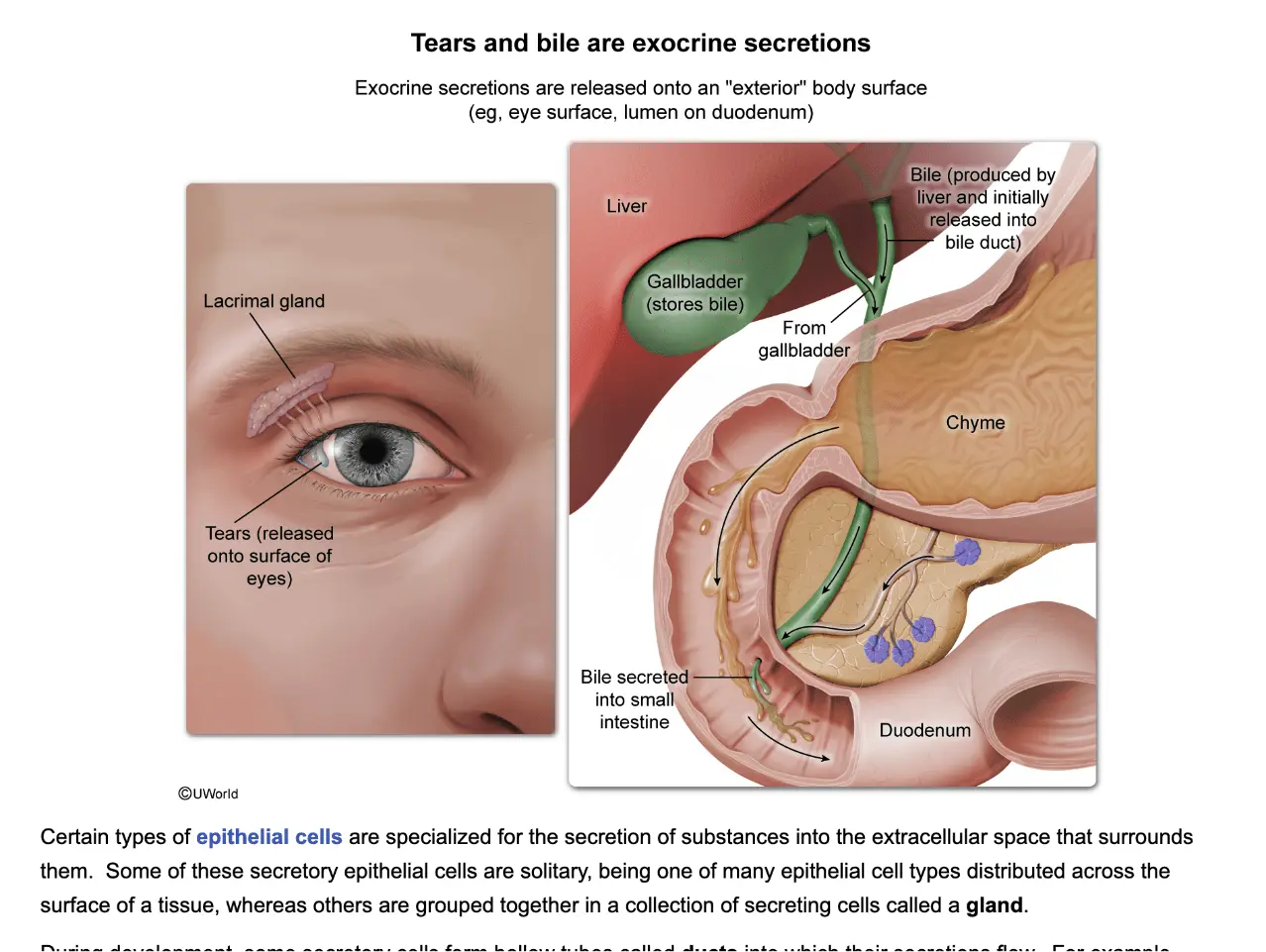
Certain types of epithelial cells are specialized for the secretion of substances into the extracellular space that surrounds them.  Some of these secretory epithelial cells are solitary, being one of many epithelial cell types distributed across the surface of a tissue, whereas others are grouped together in a collection of secreting cells called a gland.

During development, some secretory cells form hollow tubes called ducts into which their secretions flow.  For example, mammary glands secrete breast milk through ducts connected to the body’s exterior via the nipple, and sweat glands secrete sweat into ducts that empty onto the skin’s surface via pores.  Glands whose secretions are released onto an “exterior” body surface (such as the skin or the inner surface of the lung) are called exocrine glands.

Other secretory epithelial cells develop around blood vessels but lack ducts; these cells release their secretions, called hormones, into the blood.  Glands composed of cells such as these are called endocrine glands.

Some organs contain both endocrine and exocrine cells.  For example, the pancreas secretes both digestive enzymes (an exocrine secretion) and insulin and glucagon, which are hormones (endocrine secretions).

The question asks for the pair of substances that would be secreted from exocrine glands.  Tears are secreted onto the eye’s surface from lacrimal glands near the eyes, and bile is secreted from the liver into the bile duct, from which it is released into the duodenum of the small intestine (recall that the epithelial surfaces of the stomach, intestines, and lungs border cavities that are in communication with the exterior of the body).  Therefore, tears and bile are both secreted from exocrine glands.

(Choices A, B, and C)  Insulin and glucagon are hormones.  Because hormones are secreted into the blood from endocrine glands, these choices are not examples of pairs of substances secreted from exocrine glands.

Educational objective:
Both endocrine and exocrine cells are epithelial cells that produce substances released into the extracellular space.  Exocrine secretions are released to the body’s “exterior,” such as the skin or the inner surface of the gut or lungs.  Endocrine secretions are released into the blood.

General Chemistry accounts for 30% of the Chemical and Physical Foundations and 5% of the Biological and Biochemical Foundations sections, covering atomic structure, chemical equilibrium, thermodynamics, and electrochemistry.

2 Bi(s) + 5 F2(g) → 2 BiF5(s)

Metallic, elemental bismuth reacts with yellow fluorine gas to form a white solid of bismuth(V) fluoride according to the balanced equation above. How many grams of fluorine gas are needed to fully convert 836 g of bismuth in this reaction?

  1. A. 60.8 g
  2. B. 152 g
  3. C. 190 g
  4. D. 380 g

UWorld MCAT sample question about reaction stoichiometry

The molar mass of a compound is the amount of mass contained in 1 mole of the compound (ie, the grams per mole) and can be used to convert the mass of a compound to the equivalent number of moles. As such, the number of moles of Bi(s) in an 836 g sample can be found by dividing the mass of Bi(s) by its molar mass from the periodic table:

836 g Bi(s) × 1  mol Bi ( s ) 209 g Bi(s) = 4.00  mol Bi ( s )

The number of moles of a chemical species is related to the number of moles of another chemical species in a reaction by the mole ratios of the stoichiometric coefficients from a balanced reaction equation.The given balanced reaction equation shows that 5 mol of F2(g) are consumed for every 2 mol of Bi(s) that reacts. Applying this mole ratio, the number of moles of F2(g) needed to fully convert the Bi(s) sample in the reaction is:

4.00 mol Bi(s) × 5  mol  F 2 ( g ) 2 mol Bi(s) = 10.0  mol  F 2 ( g )

The mass of this number of moles of F2(g) can be found by multiplying the moles of F2(g) by its molar mass calculated from the periodic table (ie, molar mass F2(g) = 2 × 19.0 g/mol = 38.0 g/mol).

10.0 mol F₂(g) × 38.0  g  F 2 ( g ) 1 mol F₂(g) = 380  g  F 2 ( g )

(Choice A) A mass of 60.8 g results if the mole ratio 5  mol  F 2 ( g ) 2  mol Bi ( s ) is mistakenly inverted as 2  mol Bi ( s ) 5  mol  F 2 ( g ) during the second step of the calculation.

(Choice B) A mass of 152 g is obtained by incorrectly assuming a 1:1 mole ratio for F2(g):Bi(s) during the second step of the calculation.

(Choice C) A mass of 190 g is calculated if the molar mass of F (19.0 g/mol) is used instead of the molar mass of F2(g) (38.0 g/mol) in the last step of the calculation.

Educational objective:
The molar mass (the amount of mass in 1 mole of a compound) permits conversions between a given amount of mass and the number of moles that it contains. Stoichiometric mole ratios from a balanced reaction equation relate the number of moles of a chemical species to the moles of another chemical species in a reaction.

Organic Chemistry accounts for 15% of the Chemical and Physical Foundations and 5% of the Biological and Biochemical Foundations sections, covering reaction mechanisms, functional groups, stereochemistry, and laboratory techniques.

Consider the reaction below.

UWorld MCAT sample question about purification and purity

Which of the following observations would most likely indicate that the product from this reaction is pure?

  1. A. One absorbance peak from size-exclusion chromatography
  2. B. Two peaks in a high-performance liquid chromatogram
  3. C. Two unique −CH3 signals in the 1H NMR spectrum
  4. D. A single spot in the reaction mixture lane on a thin-layer chromatography plate

UWorld MCAT question about purification and purity

Several techniques can be used to evaluate the purity of a compound, including thin-layer chromatography (TLC), which separates compounds in a mixture based on polarity. In TLC, the tested sample is dissolved in an organic solvent and a small amount is spotted onto the stationary phase (commonly a polar silica [SiO2]) coated on a TLC plate. After spotting, the TLC plate is placed in a solvent chamber, and the mobile phase (organic solvent) travels up the plate and carries the spotted compounds along at different rates, which separates the mixture components. Nonpolar compounds have less affinity for a polar stationary phase and will travel further up the plate than polar compounds.

The conversion of theobromine to caffeine results in N-methylation (conversion of N–H to N–CH3), resulting in a large change in polarity. The N–H in theobromine can hydrogen bond to the polar stationary phase on the TLC plate, whereas the N–CH3 in caffeine cannot hydrogen bond. Because theobromine can hydrogen bond, it is more polar and has a smaller Rf value than caffeine, and it produces distinguishably different spots on a TLC plate. Therefore, TLC can be used to assess product purity by comparing a standard of pure theobromine to the isolated product. If a single spot with a larger Rf than that of theobromine is visible on the reaction mixture lane on the TLC plate, this indicates that the reaction proceeded to completion, no more reactant remained, and the isolated product is pure.

(Choice A) Size-exclusion chromatography separates compounds by size; therefore, compounds that are similar in size elute together. Theobromine and caffeine are very similar in size, differing only by a methylene group. Size-exclusion chromatography is unlikely to provide enough resolution to distinguish the two molecules; instead, they are likely to elute together and appear in one peak.

(Choice B) Although high-performance liquid chromatography (HPLC) can be used to determine product purity, a pure reaction product would show only one peak (not two) on the HPLC chromatogram.

(Choice C) There are three unique methyl (−CH3) groups in the reaction product caffeine; therefore, three unique −CH3 signals would be seen in its 1NMR spectrum. Two unique −CH3 signals would indicate the product had not formed because the reactant (ie, theobromine) has only two unique −CH3 groups.

Educational objective:
Thin-layer chromatography (TLC) is a technique used to evaluate a compound’s purity. The components of a mixture are separated based on polarity, and a single spot on a TLC plate is indicative of a compound’s purity.

Physics accounts for 25% of the Chemical and Physical Foundations of Biological Systems section, covering mechanics, fluids, thermodynamics, electricity, optics, and wave behavior as they apply to biological and medical contexts.

A musician plays the trumpet in a marching band. The musician tunes the trumpet inside a room and then goes outside to play. When outside, the trumpet sounds flat (plays a lower frequency). Which of the following could account for the decrease in the frequency?

  1. A. The air outside is warmer than inside, which increased the speed of the sound waves.
  2. B. More energy is dissipated outside, which caused the sound waves to lose energy.
  3. C. The musician shortened the length of the trumpet, which decreased the wavelength of the sound waves.
  4. D. The air outside is cooler than inside, which decreased the speed of the sound waves.

UWorld MCAT sample question about sound propagation

wave is a motion created by a disturbance in a medium.  A wave moves through the medium with a speed v that is related to the wavelength λ and frequency f:

v = λ f

Rearranging, the frequency of a sound wave is directly proportional to v and inversely proportional to λ:

f = v λ

The speed of waves is determined by the physical properties of the medium through which they travel.  For example, the speed of sound waves depends on the temperature of the medium: sound travels faster in warmer air and slower in cooler air.  In particular, the speed of sound in air follows the following formula (in kelvin, K):

v = 331 m s T 273  K

Consequently, when the wavelength is constant, an increase (or decrease) in wave speed results in a corresponding increase (or decrease) in the wave’s frequency.

In this question, the air in a trumpet’s tube exhibits resonances at certain wavelengths that are determined by the length of the tube. If the tube length is fixed, any decrease in resonant frequency is caused by a decrease in v. Therefore, the decrease in frequency (flat sound) can be accounted for by the air outside being cooler than the air inside, which decreases the speed of the sound waves.

(Choice A)  Sound waves travel faster in warmer air.  Hence, the speed of sound waves increases, causing the frequency to increase, not decrease.

(Choice B)  The energy of a wave is related to the wave’s intensity and loudness. Dissipation of energy does not affect the frequency of a wave.

(Choice C)  The wavelength of a sound wave produced by a brass instrument depends on the length of the tube.  A shorter trumpet results in a shorter wavelength and a higher frequency.

Educational objective:
The frequency of sound is directly related to wave speed and inversely related to wavelength.  Sound waves travel faster in warmer air and slower in cooler air.

The Critical Analysis and Reasoning Skills (CARS) section is a standalone section accounting for 25% of the total MCAT, testing your ability to read closely and evaluate arguments within the humanities and social sciences.
Questions 1-6 refer to the passage below

Locomotives were invented in England, with the first major railroad connecting Liverpool and Manchester in 1830. However, it was in America that railroads would be put to the greatest use in the nineteenth century. On May 10, 1869, the Union Pacific and Central Pacific lines met at Promontory Point, Utah, joining from opposite directions to complete a years-long project—the Transcontinental Railroad. This momentous event connected the eastern half of the United States with its western frontier and facilitated the construction of additional lines in between. As a result, journeys that had previously taken several months by horse and carriage now required less than a week’s travel. By 1887 there were nearly 164,000 miles of railroad tracks in America, and by 1916 that number had swelled to over 254,000.

While the United States still has the largest railroad network in the world, it operates largely in the background of American life, and citizens no longer view trains with the sense of importance those machines once commanded. Nevertheless, the economic and industrial advantages those citizens enjoy today would not have been possible without America’s history of trains; as Tom Zoellner reminds us, “Under the skin of modernity lies a skeleton of railroad tracks.” Although airplanes and automobiles have now assumed greater prominence, the time has arrived for the resurgence of railroads. A revitalized and advanced railway system would confer numerous essential benefits on both the United States and the globe.

The chief obstacles to garnering support for such a project are the current dominance of the automobile and the languishing technology of existing railroads. In a sense these two obstacles are one, as American dependence on personal automobiles is partially due to the paucity of rapid public transportation. The railroads of Europe and Japan, by comparison, have vastly outpaced their American counterparts. Japan has operated high-speed rail lines continuously since 1964, and in 2007, a French train set a record of 357 miles per hour. While that speed was achieved under tightly controlled conditions, it still speaks to the great disparity in railroad development between the United States and other countries since the mid-twentieth century. British trains travel at speeds much higher than those in America, where both the trains themselves and the infrastructure to support them have simply been allowed to fall behind. In much of Europe it is common for trains to travel at close to 200 miles per hour.

To invest in a modern network of railroads would improve the United States in much the same way that the first railroads did in the nineteenth and early twentieth centuries. A high-speed passenger rail system would dramatically transform American life as travel between cities and states became quicker and more convenient, encouraging commerce, business, and tourism. Such a system would also make important strides in environmental preservation. According to a 2007 British study, “CO2 emissions from aircraft operations are…at least five times greater” than those from high-speed trains. For similar reasons, Osaka, Japan, was ranked as “the best…green transportation city in Asia” by the 2011 Green City Index. As Lee-in Chen Chiu notes in The Kyoto Economic Review, Osakans travel by railway more than twice as much as they travel by car.

It is true that developing a countrywide high-speed rail system would come with significant costs. However, that was also true of the original Transcontinental Railroad, as indeed it is with virtually any great project undertaken for the public good. We should thus move ahead with confidence that the rewards will outweigh the expenditure as citizens increasingly choose to travel by train. Both for society’s gain and the crucial well-being of the planet, our path forward should proceed upon rails.

Which of the following passage assertions is the most essential for readers to accept in order for them to find the author’s argument reasonable?

A. The airline and car industries have undue influence over American travel.
B. A high-speed railroad network would encourage economic activity.
C. The superiority of foreign railroads disadvantages America in international trade.
D. The public would readily adopt high-speed rail travel if it were available.

Although airplanes and automobiles have now assumed greater prominence, the time has arrived for the resurgence of railroads. A revitalized and advanced railway system would confer numerous essential benefits on both the United States and the globe. (Paragraph 2)

In a sense these two obstacles are one, as American dependence on personal automobiles is partially due to the paucity of rapid public transportation. (Paragraph 3)

A high-speed passenger rail system would dramatically transform American life as travel between cities and states became quicker and more convenient, encouraging commerce, business, and tourism. Such a system would also make important strides in environmental preservation. According to a 2007 British study, “CO2 emissions from aircraft operations are…at least five times greater” than those from high-speed trains. (Paragraph 4)

We should thus move ahead with confidence that the rewards will outweigh the expenditure as citizens increasingly choose to travel by train. Both for society’s gain and the crucial well-being of the planet, our path forward should proceed upon rails. (Paragraph 5)

The author’s argument is that America should build a high-speed rail system because doing so would grant “numerous essential benefits on both the United States and the globe” (Paragraph 2). These benefits include “encouraging commerce, business, and tourism” as well as making “important strides in environmental preservation” (Paragraph 4). However, those benefits would occur only if the public is willing to use high-speed rail as a frequent mode of transportation.

The author suggests that this willingness exists. For instance, Paragraph 3 states that “American dependence on personal automobiles is partially due to the paucity (lack) of rapid public transportation,” implying that Americans would use such transportation if they had access to it. Likewise, Paragraph 5 makes this point more explicitly by asserting that “the rewards [of high-speed rail] will outweigh the expenditure as citizens increasingly choose to travel by train.”

Nevertheless, if American citizens continued to depend mostly on airplanes and cars even with high-speed trains available, then such trains would not actually provide the benefits that the author envisions. Consequently, for readers to find the author’s argument reasonable, it is most essential for them to accept the assertion that the public would readily adopt high-speed rail travel if it were available.

(Choice A) The airline and car industries have undue influence over American travel. Paragraph 2 states that “airplanes and automobiles have now assumed greater prominence” compared to trains in America, and Paragraph 3 cites “the current dominance of the automobile” as an obstacle to support for high-speed trains. Accordingly, the author would likely agree that the airline and car industries have undue influence over American travel. However, his or her argument depends more crucially on the idea that those industries’ influence is caused by “the paucity of rapid public transportation” (Paragraph 3), and thus that the public would readily adopt high-speed rail travel if it were available.

(Choice B) A high-speed railroad network would encourage economic activity. According to Paragraph 4, “A high-speed passenger rail system would dramatically transform American life…encouraging commerce, business, and tourism.” However, these economic benefits (as well as any environmental ones) could only be realized if citizens choose to embrace this mode of transportation. Therefore, the assertion that a high-speed railroad network would encourage economic activity is less essential to the author’s argument than the idea that the public would adopt high-speed rail travel once it is available.

(Choice C) The superiority of foreign railroads disadvantages America in international trade. Paragraph 3 states that “[t]he railroads of Europe and Japan…have vastly outpaced their American counterparts.” Although this statement indicates that foreign railroads are superior to those in America, the author’s argument is not based on the idea that building high-speed railroads would improve America’s international trade. Rather, the author claims that “travel between [American] cities and states would become quicker and more convenient” and that such railroads would “make important strides in environmental preservation” (Paragraph 4).

Which of the following is most like the relationship between American railroads and British railroads as they are described in the passage?

A. An apprentice artist surpasses a master’s early works but does not live up to the master’s later works.
B. A financial investor earns large sums of money in the short term but loses a larger amount over time.
C. A rookie athlete sets a team record but in later seasons his record is broken by a newer player.
D. An investigative journalist races to break a story but is beaten to the punch by a rival network.

Locomotives were invented in England, with the first major railroad connecting Liverpool and Manchester in 1830. However, it was in America that railroads would be put to the greatest use in the nineteenth century. (Paragraph 1)

While that speed was achieved under tightly controlled conditions, it still speaks to the great disparity in railroad development between the United States and other countries since the mid-twentieth century. British trains travel at speeds much higher than those in America, where both the trains themselves and the infrastructure to support them have simply been allowed to fall behind. (Paragraph 3)

According to the passage, the first American trains overshadowed their British counterparts, but in modern times British trains are superior. For instance, Paragraph 1 conveys that although “[l]ocomotives were invented in England…it was in America that railroads would be put to the greatest use in the nineteenth century.” Paragraph 3 then explains that there has been a “great disparity in railroad development between the United States and other countries since the mid-twentieth century.” In particular, “British trains travel at speeds much higher than those in America, where both the trains themselves and the infrastructure to support them have simply been allowed to fall behind.”

Therefore, this relationship is most analogous to a situation in which an apprentice artist surpasses a master’s early works but does not live up to the master’s later works. Like the British railroads, the original artist (the master) was first surpassed, but his later works re-established his superior position.

By contrast, none of the following situations is most analogous to the relationship between American railroads and British railroads, because they do not include a re-established superiority:

  • A financial investor earns large sums of money in the short term but loses a larger amount over time (Choice B). There is no suggestion in this analogy that such an investor later recoups her losses. Moreover, her situation is not described in relation to another entity that surpasses her.

  • A rookie athlete sets a team record but in later seasons his record is broken by a newer player (Choice C). In the scenario described, the rookie’s record is later broken by a newer player, not by the previous record holder. Accordingly, while the newer player sets a superior record, he does not re-establish his superiority.

  • An investigative journalist races to break a story but is beaten to the punch by a rival network (Choice D). There is no suggestion in this analogy that the journalist later beats the rival network to the punch on other stories.

For which of the following passage claims does the author provide supporting evidence?

A. Developing a countrywide high-speed rail system would come with significant costs.
B. A high-speed passenger rail system would dramatically transform American life.
C. The United States still has the largest railroad network in the world.
D. Increasing the use of high-speed railroads would be beneficial for the environment.

A high-speed passenger rail system would dramatically transform American life as travel between cities and states became quicker and more convenient, encouraging commerce, business, and tourism. Such a system would also make important strides in environmental preservation. According to a 2007 British study, “CO2 emissions from aircraft operations are…at least five times greater” than those from high-speed trains. For similar reasons, Osaka, Japan, was ranked as “the best…green transportation city in Asia” by the 2011 Green City Index. As Lee-in Chen Chiu notes in The Kyoto Economic ReviewOsakans travel by railway more than twice as much as they travel by car. (Paragraph 4)

Paragraph 4 states that a high-speed rail system would “make important strides in environmental preservation.” The author then supports this claim with data comparing the environmental effects of rail travel to those of travel by airplane or automobile: “According to a 2007 British study, ‘CO2 emissions from aircraft operations are…at least five times greater’ than those from high-speed trains.” Similarly, “Osaka, Japan, was ranked as ‘the best…green transportation city in Asia’ by the 2011 Green City Index,” and “Osakans travel by railway more than twice as much as they travel by car.”

Therefore, the author provides supporting evidence for the claim that increasing the use of high-speed railroads would be beneficial for the environment.

By contrast, the author provides no supporting evidence for the following claims:

  • Developing a countrywide high-speed rail system would come with significant costs (Choice A). According to Paragraph 5, “developing a countrywide high-speed rail system would come with significant costs.” However, the author makes this assertion without providing any specific information regarding such costs.

  • A high-speed passenger rail system would dramatically transform American life (Choice B). Paragraph 4 states that “[a] high-speed passenger rail system would dramatically transform American life as travel between cities and states became quicker and more convenient, encouraging commerce, business, and tourism.” However, the author provides no data to support the idea that such a transformation would occur.

  • The United States still has the largest railroad network in the world (Choice C). Paragraph 1 states that “[b]y 1887 there were nearly 164,000 miles of railroad tracks in America, and by 1916 that number had swelled to over 254,000.” Paragraph 2 then asserts that “the United States still has the largest railroad network in the world.” However, this assertion is not supported by evidence because the author does not provide the current total mileage of railroad tracks in America nor compare that number to the mileage of other countries’ railroad networks.

How would the author’s argument be impacted if studies suggest there is an increasing trend of people using ride-sharing services for transportation?

A. It would refute the author’s suggestion that trains would help fill a transportational need.
B. It would weaken the author’s comparison between the Transcontinental Railroad and high-speed rail.
C. It would support the author’s assumption that the public could be willing to depend less on vehicle ownership.
D. It would reinforce the author’s claim that automobiles have made public transportation less important

The chief obstacles to garnering support for such a project are the current dominance of the automobile and the languishing technology of existing railroads. In a sense these two obstacles are one, as American dependence on personal automobiles is partially due to the paucity of rapid public transportation. The railroads of Europe and Japan, by comparison, have vastly outpaced their American counterparts. (Paragraph 3)

We should thus move ahead with confidence that the rewards will outweigh the expenditure as citizens increasingly choose to travel by train. (Paragraph 5)

Part of the author’s argument is that Americans would use more public transportation if it were feasible, but they are often forced to depend on vehicle ownership out of necessity. For example, Paragraph 3 connects the “current dominance of the automobile” in American life to the “languishing (neglected or weakened) technology of existing railroads,” and asserts that “American dependence on personal automobiles is partially due to the paucity (lack) of rapid public transportation.” Similarly, in Paragraph 5 the author asserts that if a high-speed rail network were built, “citizens [would] increasingly choose to travel by train,” which would reduce the need for them to own cars.

Thus, if there is an increasing trend of people using ride-sharing services for transportation, this trend would indicate that people are moving away from depending on their own vehicles for travel. Accordingly, such a trend would support the author’s assumption that the public could be willing to depend less on vehicle ownership.

(Choice A) It would refute the author’s suggestion that trains would help fill a transportational need. The author advocates high-speed rail as a way to address “the paucity of rapid public transportation” (Paragraph 3) in America. In addition, he or she implies that such a rail system would help take the place of air travel, noting that “‘CO2 emissions from aircraft operations are…at least five times greater’ than those from high-speed trains” (Paragraph 4). Thus, a trend toward increased use of ride-sharing services suggests a need for additional transportation options which trains might also help to fill. Moreover, ride-sharing is unlikely to replace air travel as the author suggests high-speed rail might do. Therefore, an increasing trend of people using ride-sharing services for transportation would not refute the idea that trains would help fill a transportational need.

(Choice B) It would weaken the author’s comparison between the Transcontinental Railroad and high-speed rail. According to Paragraph 5, “developing a countrywide high-speed rail system would come with significant costs. However, that was also true of the original Transcontinental Railroad, as indeed it is with virtually any great project undertaken for the public good.” Therefore, the author compares the Transcontinental Railroad and modern high-speed rail as ambitious but costly projects designed for society’s benefit. The basis for this comparison is not affected by an increase in the number of people using ride-sharing services.

(Choice D) It would reinforce the author’s claim that automobiles have made public transportation less important. Paragraph 3 states that “American dependence on personal automobiles is partially due to the paucity of rapid public transportation.” Accordingly, the author argues that there is a lack of effective public transportation in America, to which the predominance of automobiles is a response. However, he or she does not claim that automobiles have made public transportation less important.

In the context of the passage, which of the following best explains Zoellner’s claim that “[u]nder the skin of modernity lies a skeleton of railroad tracks”?

A. American trains now represent an obsolete technology.
B. American trains have been overshadowed by other forms of transportation.
C. American trains have been largely retired from use in current society.
D. American trains have been crucial in producing the country as we know it.

While the United States still has the largest railroad network in the world, it operates largely in the background of American life, and citizens no longer view trains with the sense of importance those machines once commanded. Nevertheless, the economic and industrial advantages those citizens enjoy today would not have been possible without America’s history of trains; as Tom Zoellner reminds us, “Under the skin of modernity lies a skeleton of railroad tracks.” (Paragraph 2)

According to Paragraph 2, American citizens “no longer view trains with the sense of importance those machines once commanded.” However, the author points out that “the economic and industrial advantages those citizens enjoy today would not have been possible without America’s history of trains; as Tom Zoellner reminds us, ‘Under the skin of modernity lies a skeleton of railroad tracks.'” Therefore, the passage presents Zoellner’s quote as an elaboration of the idea that America’s past use of railroads was essential to producing the country’s modern way of life.

Consequently, in the context of the passage, Zoellner’s claim indicates that American trains have been crucial in producing the country as we know it.

By contrast, in the context of the passage, Zoellner’s claim does not indicate that:

  • American trains now represent an obsolete technology (Choice A). Paragraph 3 states that “in America…both the trains themselves and the infrastructure to support them have simply been allowed to fall behind,” which suggests that to some extent American trains represent an obsolete technology. However, the passage does not connect Zoellner’s quote to that idea, but instead to the claim that the advantages of modern society “would not have been possible without America’s history of trains” (Paragraph 2).

  • American trains have been overshadowed by other forms of transportation (Choice B). According to Paragraph 2, “airplanes and automobiles have now assumed greater prominence” in America. However, Zoellner’s quote is used to indicate the past role of railroads in producing “the economic and industrial advantages [American] citizens enjoy today.” The passage does not connect Zoellner’s quote to the idea that trains have been overshadowed.

  • American trains have been largely retired from use in current society (Choice C). According to the passage, “the United States still has the largest railroad network in the world,” even though “it operates largely in the background of American life” (Paragraph 2).

Of the following passage claims, which could most easily be confirmed or refuted?

A. Americans no longer view trains with the sense of importance they once commanded.
B. The railroads of Europe and Japan have vastly outpaced their American counterparts.
C. An advanced railway system would benefit America economically.
D. A high-speed passenger rail system would dramatically transform American life.

The railroads of Europe and Japan, by comparison, have vastly outpaced their American counterparts. Japan has operated high-speed rail lines continuously since 1964, and in 2007, a French train set a record of 357 miles per hour…. British trains travel at speeds much higher than those in America, where both the trains themselves and the infrastructure to support them have simply been allowed to fall behind. In much of Europe it is common for trains to travel at close to 200 miles per hour. (Paragraph 3)

One of the author’s points in arguing for a high-speed rail system in America is that trains in other countries are now much more advanced. According to Paragraph 3, “[t]he railroads of Europe and Japan…have vastly outpaced their American counterparts.” For example, “Japan has operated high-speed rail lines continuously since 1964, and in 2007, a French train set a record of 357 miles per hour.” Meanwhile, in America, “both the trains themselves and the infrastructure to support them have simply been allowed to fall behind. In much of Europe it is common for trains to travel at close to 200 miles per hour.”

These comparisons between the trains of America and those of Europe and Japan are based on currently existing, measurable data points concerning factors such as speed and years of operation. Accordingly, the claim that the railroads of Europe and Japan have vastly outpaced their American counterparts could most easily be confirmed or refuted.

(Choice A) Americans no longer view trains with the sense of importance they once commanded. Although it could be true that American citizens “no longer view trains with the sense of importance those machines once commanded” (Paragraph 2), it is difficult to directly confirm or refute such a general claim about people’s views and opinions.

(Choice C) An advanced railway system would benefit America economically. The author asserts that an advanced railway system would promote “commerce, business, and tourism” (Paragraph 4). However, that claim is a projection rather than something which can be measured at present. Accordingly, it is difficult to confirm or refute whether an advanced railway system would in fact benefit America economically as the author claims.

(Choice D) A high-speed passenger rail system would dramatically transform American life. The author claims that “[a] high-speed passenger rail system would dramatically transform American life, as travel between cities and states would become quicker and more convenient, encouraging commerce, business, and tourism” (Paragraph 4). However, this claim concerns what the author expects to occur in the future, which cannot be directly confirmed or refuted in the present.

Which of the following statements, if true, would most challenge the author’s argument for the value of building a high speed rail system in America?

A. On average, the distance between travel destinations is shorter in Europe than it is in America.
B. The slower speeds of trains in America compared to those in Europe are due to safety issues with American trains.
C. The primary use of existing American trains is the transport of freight rather than passengers.
D. The process of constructing high-speed rail could affect the environment in unpredictable ways.

Although airplanes and automobiles have now assumed greater prominence, the time has arrived for the resurgence of railroads. A revitalized and advanced railway system would confer numerous essential benefits on both the United States and the globe. (Paragraph 2)

We should thus move ahead with confidence that the rewards will outweigh the expenditure as citizens increasingly choose to travel by train. Both for society’s gain and the crucial well-being of the planet, our path forward should proceed upon rails. (Paragraph 5)

One of the author’s main reasons for advocating the construction of high-speed rail is that this mode of transportation is environmentally conscious. For example, in Paragraph 2 the author states that “[a] revitalized and advanced railway system would confer (grant) numerous essential benefits on both the United States and the globe.” Likewise, he or she concludes by stating that “for society’s gain and the crucial well-being of the planet, our path forward should proceed upon rails” (Paragraph 5).

Accordingly, the author’s argument for the value of building a high-speed rail system in America depends heavily on the idea that such a system would benefit the environment. However, if the process of constructing high-speed rail could affect the environment in unpredictable ways, that would raise the possibility that such construction could cause negative environmental effects, not just the positive ones that the author describes. As that possibility could undercut the author’s justification for building a high-speed rail system, the author’s argument would be most challenged if that claim were true.

(Choice A) On average, the distance between travel destinations is shorter in Europe than it is in America. The author advocates high-speed rail in part because “‘CO2 emissions from aircraft operations are…at least five times greater’ than those from high-speed trains” (Paragraph 4). This comparison implies that high-speed rail transportation can replace air travel, which typically covers long distances. Therefore, if the average distance between travel destinations is shorter in Europe than it is in America, that fact would reinforce the idea that America would benefit from a high-speed rail system.

(Choice B) The slower speeds of trains in America compared to those in Europe are due to safety issues with American trains. Paragraph 3 states that “in America…both the trains themselves and the infrastructure to support them have simply been allowed to fall behind,” whereas “[i]n much of Europe it is common for trains to travel at close to 200 miles per hour.” Accordingly, if American trains are unable to safely match the speed of European trains, this fact would be consistent with the author’s descriptions of American and European trains. Thus, safety concerns about American trains would support the author’s argument that America’s railways should be updated to match their faster and safer European counterparts.

(Choice C) The primary use of existing American trains is the transport of freight rather than passengers. The author argues that “[a] high-speed passenger rail system would dramatically transform American life as travel between cities and states became quicker and more convenient, encouraging commerce, business, and tourism” (Paragraph 4). If the primary use of existing American trains is the transport of freight rather than passengers, that fact would suggest a current lack of passenger trains. Therefore, this statement would likely support rather than challenge the author’s argument about the value of building a high-speed rail system in America.

Master CARS in 4 Easy Steps

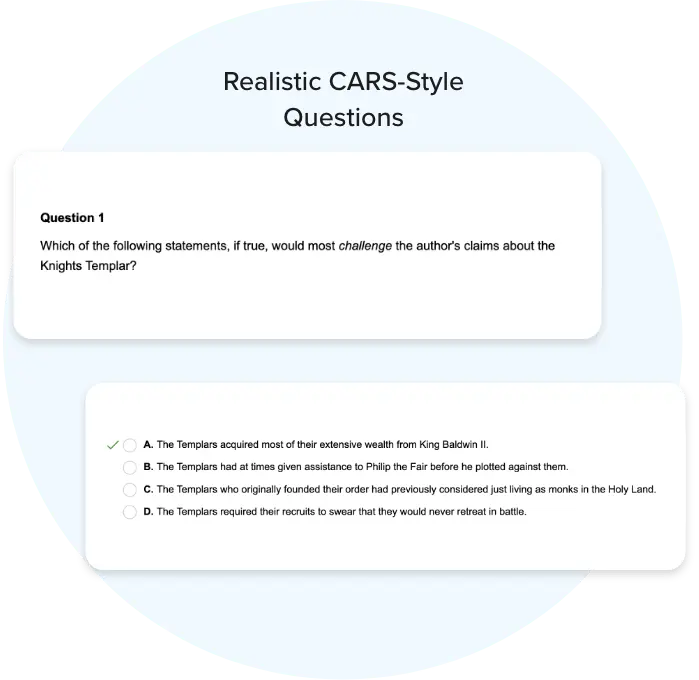
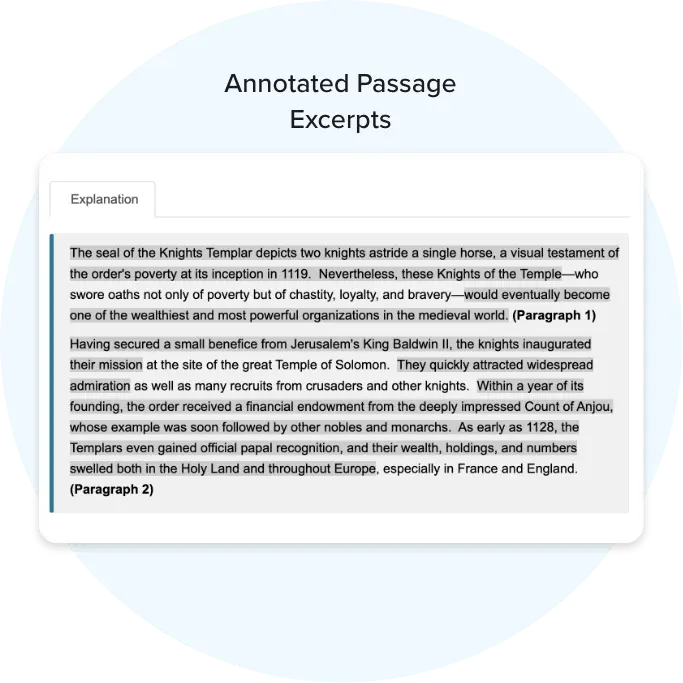
We help you overcome the most challenging CARS MCAT exam questions by teaching you how to think, not just what to memorize. Our step-by-step method uses passage excerpts and detailed rationales to simplify hard MCAT questions and sharpen your critical reasoning skills.

1
Read

Read expertly written MCAT passages representative of the CARS section.

2
Practice

Practice with realistic CARS MCAT mock questions.

3
Analyze

Highlighted passage excerpts help you pinpoint the correct answer.

4
Review

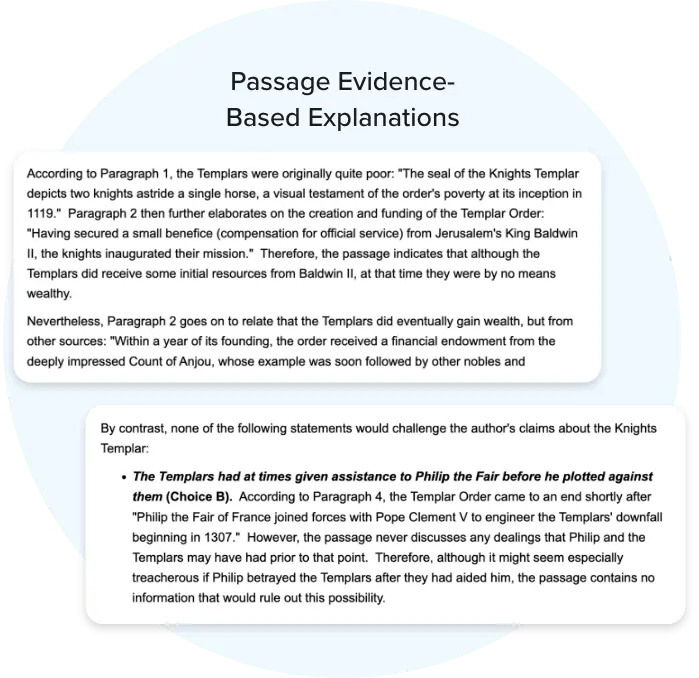
Build critical reasoning skills with our passage evidence-based explanations.
Smarter Study Tools. Faster Results.

Study smarter with data-driven learning tools designed to accelerate learning. From performance analytics that pinpoint knowledge gaps to spaced repetition flashcards that lock in difficult concepts, our powerful study tools help you maximize your review, so you can walk into test day with complete confidence.

New!

UWorld Practice Exams

Assess Your Exam Readiness

Gauge your MCAT readiness and simulate the exam with 2 full-length, scored exams featuring new MCAT review questions and detailed visual explanations.

  • Mirror real testing conditions to eliminate exam-day surprises.
  • Deepen your understanding with rich, visual answer explanations.
  • Predict your score with 472–528 scaled score reporting.
UWorld MCAT practice exam
New!

UAsk™: Your AI MCAT Tutor

Maximize Your Review With Expert Guidance

Get instant, personalized support from an AI tutor trained by UWorld's experts, seamlessly integrated into your QBank and practice exams.

  • Get unstuck in seconds without breaking your study flow.
  • Dig into concepts and get answers to all your pressing questions.
  • Access expert guidance right when you need it.
UAsk UWorld MCAT AI Tutor tool

Hyperlinked Visual Resources

Close Knowledge Gaps with Visual Learning

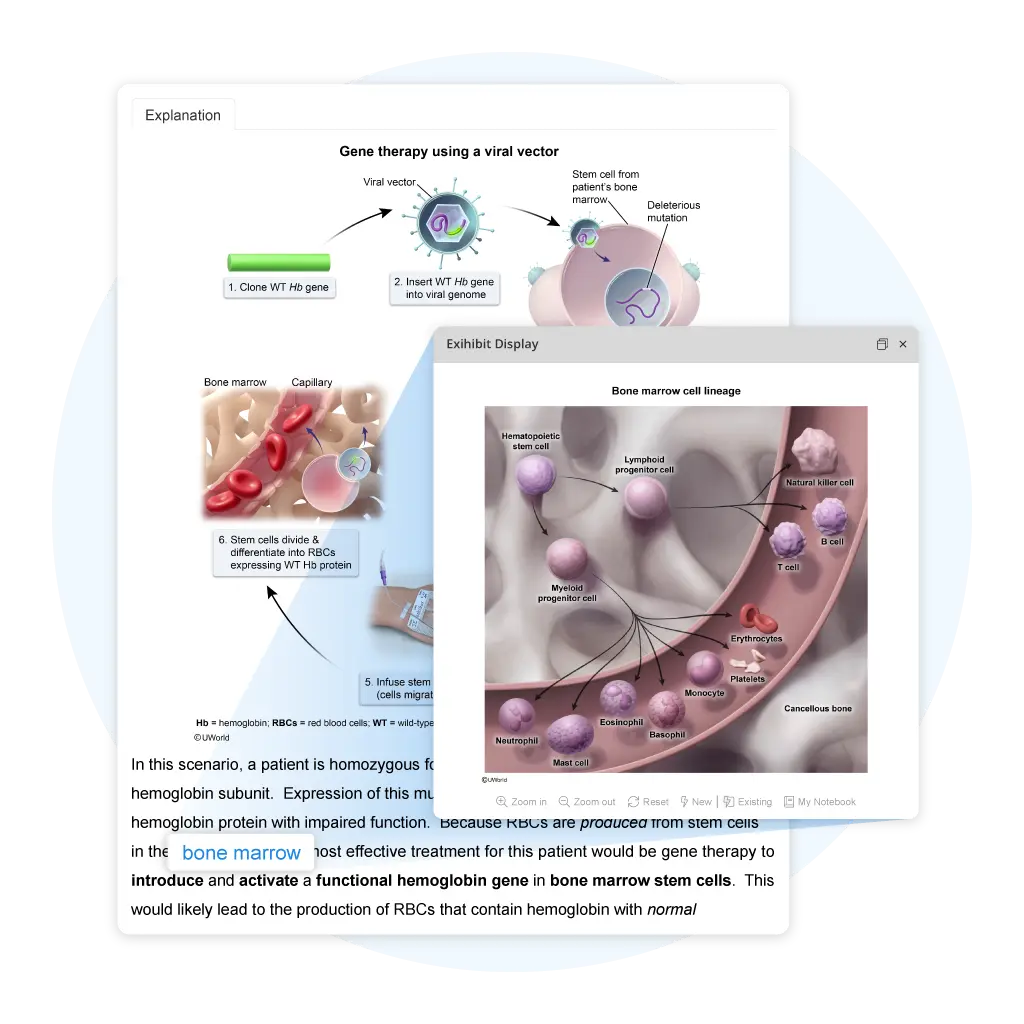
Don't just read explanations, actively explore them with interactive hyperlinked images that bring difficult concepts to life without breaking your work flow.

  • Simplify complex concepts with high-impact visual aids.
  • Visualize exam topics for long term retention.
  • Bridge content gaps across all MCAT subjects instantly.
UWorld MCAT hyperlinked image

Customizable Study Planner

Stay on Track with a Personalized Roadmap

Use our expert-crafted plan or build your own personalized study plan in less than a minute, so you can focus on studying, not scheduling.

  • Get a personalized roadmap for a top score in under 60 seconds.
  • Cover every essential MCAT topic with a day-by-day schedule.
  • Stay on pace with a plan that adapts to your progress.
UWorld MCAT study planner feature

Detailed Performance Analytics

Pinpoint Weaknesses with Data-Driven Insights

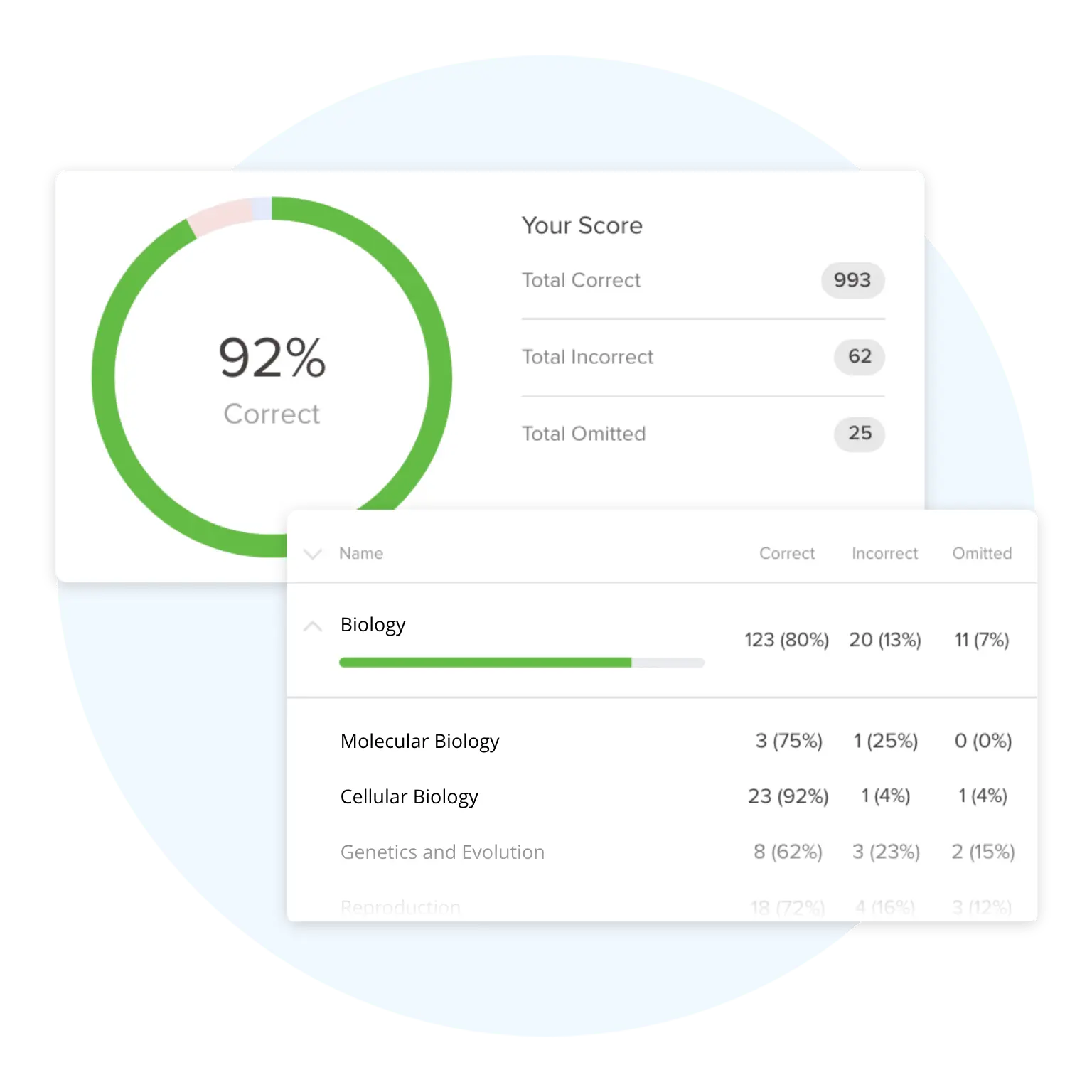
Know exactly where to focus your time with advanced reporting tools that help you identify knowledge gaps and track your improvement over time.

  • Identify weak subjects and topics quickly and improve.
  • Compare your scores against your peers to confirm your readiness.
  • Spot trends so you can course-correct before test day.
UWorld's MCAT Prep Course Performance Reports

Adaptive Flashcard Tool

Master Concepts Faster With Spaced Repetition

Create unlimited flashcards and close content gaps faster with an adaptive, spaced-repetition flashcard tool that prioritizes what you need most for exam-day success.

  • Create your own flashcards using trusted UWorld content.
  • Skip low-yield content and focus on what you need most.
  • Prioritize your weaknesses with spaced repetition technology.
UWorld MCAT flashcard Tool
AppStore Icon

Practice MCAT Questions On-The-Go

Maximize your score with our mobile app by practicing a few questions or reviewing your flashcards on a break or in between classes.

MCAT QBank Users Who Raised Their Scores

Hear what real students like you have to say about UWorld’s MCAT question bank.

Ready to Start Scoring Higher?

Sharpen your skills and build test-day confidence with our representative MCAT QBank or select our Comprehensive Prep Course for an all-in-one solution for a top MCAT score.

MCAT QBank FAQs

With your future on the line, you need more than just another QBank. UWorld delivers what other platforms can’t:

  1. Explanations That Actually Explain: You’ll see exactly why each answer is right or wrong with our visual, step-by-step breakdowns. Unlike text-heavy competitors, we ensure you truly understand the material, not just memorize it.
  2. Practice That Feels Like the Real Thing: Our 3,000+ AAMC-style questions and practice exams prepare you for the exact type of critical reasoning and passage analysis you’ll face. Other QBanks test memorization; we test (and build) your ability to think like a doctor.
  3. Study Efficiently, On Your Schedule: Seamlessly switch between your laptop and phone, create custom flashcards from any explanation, and build a personalized study notebook, all within one integrated system designed to maximize your time.

“The MCAT exam questions are unparalleled. No other program dedicates this much into explanations as to why questions are answered the way they do. Additionally, the UWorld MCAT Qbank is typically more challenging than actual MCAT test questions attributing to a higher score as a result.”

-Jacob P. Verified UWorld MCAT QBank User

Our MCAT exam questions move beyond memorization to boost your score by:

  • Building Critical Reasoning: MCAT prep questions are designed to challenge you with passage analysis and application of complex concepts, training the critical reasoning skills needed for a top score.
  • Simulating the Exam: The QBank and practice exam interface mirrors the real MCAT, making you confident and familiar with the software on test day, with questions representative of the actual difficulty and style.
  • Explaining the “Why”: We provide detailed, step-by-step rationales with high quality visuals for every question, explaining why answers are right and why distractors are wrong. This depth of understanding is unmatched.

“The explanations are incredible, both for learning how to eliminate incorrect answer choices, identify content gaps, and reinforce eventually getting questions on a given subject correct. The diagrams are extremely helpful for understanding information as deeply as I need to as well.”

-Nolan A. Verified UWorld MCAT QBank User

Yes! Our trial includes 100 free MCAT practice questions for 7 days. No credit card. No risk. Just a full week to see why UWorld consistently outperforms other MCAT prep. You’ll get instant access to:

  • The first interactive lesson and associated high-yield videos for every MCAT subject.
  • Expert-crafted, spaced-repetition flashcards that improve recall.
  • 100 MCAT practice questions featuring our industry-leading visual explanations.
  • Powerful study tools like the custom study plan, mobile app access, digital notebook, and performance reporting.

Ready to get started? Sign up for a FREE 7-day trial today!

The MCAT is a multidisciplinary marathon. To succeed, you need MCAT sample problems that span the entire scientific spectrum. Our 7-day trial includes 100 sample questions from MCAT content across the four exam sections:

  • Biological and Biochemical Foundations of Living Systems
  • Chemical and Physical Foundations of Biological Systems
  • Psychological, Social, and Biological Foundations of Behavior
  • Critical Analysis and Reasoning Skills (CARS)

To access 3,000+ premium questions, prep books, videos, flashcards, practice exams and the AAMC official prep resources sign up for our MCAT Comprehensive Prep Course.

There’s no single magic number; your pace depends on your study schedule. We recommend working backward from your test date and pairing practice questions with the corresponding content review.

As a general guide, if you have a 6-month plan (approx. 120 study days) and our QBank has 3,000 questions, an average of 25 questions per day is a sustainable target. You will also need to allocate time to take and review the UWorld full length practice exams.

The most crucial part is budgeting time to thoroughly review every rationale, even for questions you answered correctly, to ensure true mastery of the concepts. Avoid cramming all your practice until the last few weeks.

QBank performance is a great learning and diagnostic tool, but full-length practice exams are the most accurate predictors of a scaled score. That’s why we include 2 full length practice exams in our QBank.

Our mock MCAT questions help you succeed by:

  • Benchmarking Mastery: Consistently scoring 60% or higher indicates a strong grasp of the material.
  • Indicating Improvement: Your MCAT practice test question percentage correct should trend upward, showing you are mastering content and critical reasoning.
  • Predicting Weaknesses: Incorrect questions act as diagnostic tools, helping you fix knowledge gaps before test day.

“I have seen a great increase in my practice AAMC FL scores from using the MCAT QBank as my primary source for MCAT practice test questions.”

-Vincent V. Verified UWorld MCAT QBank User

Yes. Our MCAT QBank is meticulously designed to be a comprehensive resource for exam-like practice. All of our MCAT mock questions and practice exams are based on the AAMC MCAT blueprint, which ensures that our mcat study questions cover every topic you will encounter on the exam. While other question banks may also follow the blueprint, they lack the comprehensive, step-by-step explanations that are essential for deep learning.

Total QBank Questions: 3,000+

Subjects Covered:

  • Behavioral Sciences
  • Biochemistry
  • Biology
  • Critical Analysis & Reasoning Skills
  • General Chemistry
  • Organic Chemistry
  • Physics

Our MCAT practice questions and explanations are developed by an exceptional in-house team of 20+ authors, all of whom hold PhD or MS-level advanced degrees. This team isn’t just a collection of individuals; they are practicing professors, scientists, and researchers who are experts in the basic sciences, humanities, and social sciences covered on the exam.

Our MCAT QBank team brings a massive 241+ combined years of academic experience to your QBank. This expertise is backed by 222+ publications and 163+ awards for teaching and research. This means every MCAT question and explanation you see is written, developed, evaluated, and rigorously maintained by proven experts. They provide students with the strategies and in-depth understanding needed to maximize their MCAT score.

A high-quality example of an MCAT question must be:

  • Passage-based: Requiring you to extract data from graphs and text.
  • Reasoning-heavy: Testing your ability to apply concepts to novel situations.
  • Integrative: Combining multiple disciplines (e.g., Physics applied to Biology).
  • Explanatory: Offering a roadmap of how to arrive at the answer, not just what the answer is.

High-quality MCAT style questions like UWorld’s emphasize step-by-step explanations and visuals to help students understand why each answer choice is correct or incorrect.

Our MCAT exam practice questions and full-length practice exams are written to be highly representative of the actual exam. They don’t just cover the AAMC MCAT syllabus; they also precisely match the exam’s difficulty level and clinical reasoning focus. This ensures our test mcat questions prepare you for the complexity of the real test.

All mcat test questions are included in a simulated MCAT interface that mirrors the one you’ll see on test day. This increases your confidence and makes test day feel like another UWorld practice session.

You can practice using all the standard exam interface features, including:

  • The ability to highlight text
  • Strikethrough answer choices
  • Flag practice MCAT questions for review

This realistic simulation means you’ll feel comfortable and prepared when you take the real exam.

“The questions are very similar to questions that would be seen on the actual MCAT. The explanations are very detailed and really help in understanding the concept fully.”

-Rachel B. Verified UWorld MCAT QBank User

A high-quality QBank is essential, but we recommend a three-stage prep plan:

  1. Content Review: Start with foundational review (books/videos) to learn the science fundamentals.
  2. Practice & Application (QBank): Use the MCAT QBank as your core tool to apply knowledge, identify weak areas, and build critical reasoning skills (“learn by doing”).
  3. Full-Length Simulation: Use practice tests to build stamina and simulate the exam day experience. The QBank is the essential bridge between knowing the content and succeeding, but it works best when combined with solid content review and full-length testing.

All of UWorld’s MCAT exam practice questions are updated regularly, and our practice MCAT questions are tested rigorously to ensure students get the most effective and up-to-date content. We update our MCAT questions in real-time as our expert authors make changes. 

This commitment ensures your test mcat questions are always perfectly aligned with the current AAMC blueprint, ensuring you get the most up-to-date review. 

“Really good, this is the most representative 3rd party material compared to official AAMC materials. Definitely recommend it, I wish I found out about UWorld sooner.”

-Christopher Y. Verified UWorld MCAT QBank User

See How UWorld's MCAT QBank Stacks Up

The gap between a good score and a great score starts with the MCAT question bank you choose. From unmatched step-by-step visual explanations to integrated study tools like spaced-repetition flashcards, UWorld outperforms other MCAT QBanks where it matters most. See how we stack up across question quality, answer explanations, and study features.

Feature UWorld Other Courses
Reputation
Trusted by 99% of medical students and 400,000+ premeds Brands lack UWorld’s medical exam pedigree
Expert-Written Questions
Written by PhD & MS-level experts Utilize high-scoring students or tutors
Blueprint Alignment
Questions are mapped to the MCAT and updated regularly Can be outdated or include low-yield content
Practice Question Explanations
Visual rationales turn every mistake into a tutoring lesson Basic explanations that ignore distractor logic and lack visuals
Full-Length Practice Exams
Visual rationales that mirror the depth of our QBank explanations Standard rationales without visual feedback
CARS Strategy
4-step method builds critical reasoning skills Explanations rely on subjective reasoning
Visual Hyperlinks
Visual hyperlinks bring concepts to life Static content with no deeper navigation
Study Planner
3 Customizable plans tailored to your schedule Rigid, one-size-fits-all templates
Fully Functional Mobile App
Full QBank functionality on any device Limited features or no mobile app access
Reputation
UWorld

✔ Trusted by 99% of medical students and 400,000+ premeds

Other Courses

✖ Brands lack UWorld’s medical exam pedigree

Expert-Written Questions
UWorld

✔ Written by PhD & MS-level experts

Other Courses

✖ Utilize high-scoring students or tutors

Blueprint Alignment
UWorld

✔ Questions are mapped to the MCAT and updated regularly

Other Courses

✖ Can be outdated or include low-yield content

Practice Question Explanations
UWorld

✔ Visual rationales turn every mistake into a tutoring lesson

Other Courses

✖ Basic explanations that ignore distractor logic and lack visuals

Full-Length Practice Exams
UWorld

✔ Visual rationales that mirror the depth of our QBank explanations

Other Courses

✖ Standard rationales without visual feedback

CARS Strategy
UWorld

✔ 4-step method builds critical reasoning skills

Other Courses

✖ Explanations rely on subjective reasoning

Visual Hyperlinks
UWorld

✔ Visual hyperlinks bring concepts to life

Other Courses

✖ Static content with no deeper navigation

Study Planner
UWorld

✔ 3 customizable plans tailored to your schedule

Other Courses

✖ Rigid, one-size-fits-all templates

Fully Functional Mobile App
UWorld

✔ Full QBank functionality on any device

Other Courses

✖ Limited features or no mobile app access

MCAT Question Types

The MCAT consists of passage-based questions, which make up 80% of the exam, and discrete questions, which comprise the remaining 20% and test your grasp of core science concepts.

You can build the skillset and confidence needed to master these question types by using UWorld’s MCAT QBank, which provides high-quality sample questions that mirror the actual exam’s difficulty and phrasing.

Ready to Get Started?

Join the 400k who have raised their MCAT scores with UWorld.

Explore More MCAT Questions and Answers

Explore each MCAT subject, practice with subject-specific MCAT questions, and learn how to best use the UWorld MCAT QBank. These pillar pages break down high-yield topics and provide the targeted practice you need to master the MCAT.
Scroll to Top

See What Our Students Are Saying

Try Our MCAT Course

FREE for 7 Days

See the Difference for Yourself
No credit card required
MCAT Comprehensive Prep Course
Select Your Access
90-Day Access
$1,199
$1,199
Buy
180-Day Access
Includes One-Time Reset
$1,449
$1,449
Buy
Most Popular
360-Day Access
Includes One-Time Reset
$1,549
$1,549
Buy
MCAT Core Prep Course
Select Your Access
90-Day Access
$599
$599
Buy
180-Day Access
Includes One-Time Reset
$649
$649
Buy
Most Popular
360-Day Access
Includes One-Time Reset
$699
$699
Buy

Frequently Asked Questions

New Purchase: All new subscriptions go into effect from the time they are activated and not at the time of setup/purchase. A subscription can be activated immediately or any time thereafter. If your initial purchase consists of multiple courses (UBooks and Qbank), each can be activated individually and independently via your account on our website. This process of activating a subscription after purchase allows you the flexibility to start a subscription when you are truly ready to use it. 

We recommend that all subscriptions be activated within 180 days of setup/purchase. Once a subscription is activated, it cannot be paused or suspended for any reason and will run continuously for the duration of the course material.

Renewal: A renewal is an extension of time to continue access to a current activated subscription. Because a renewal is an extension to an already active subscription, it is effective from the existing expiration date, not from the day of purchase and cannot be deferred to start at a later date/time.

Note: All of our subscriptions are based on the Eastern Time Zone (GMT/UTC -5 hours or New York Time), which may be different from your local time zone.

Our QBank can be purchased from our website with payment due in full at time of purchase via a credit or debit card with American Express/Discover/MasterCard or Visa.

You will need to register for an account in order to purchase any of our products. Once you have registered for an account or if you already have an account:

  • Log in to your UWorld account
  • Click on the Cart icon at the top of the page and then select your desired product to see a list of available packages and their prices
  • Select the package you wish to purchase
  • Verify your profile information, address, and educational status, then click the Update button
  • Enter your Billing address and credit/debit card information, then click Review Order
  • Verify that the correct product is in your cart and click Place Order
  • A purchase receipt will automatically be sent to your registered email address

If you complete your purchase but do not receive a receipt, please contact the Customer Care Team at [email protected]

You can purchase a QBank subscription using a credit or debit card with a Visa, MasterCard, Discover or American Express. After a successful payment, your subscription will immediately be available for activation via your account on our website or available complementary mobile applications.

You can also subscribe via personal check, money order, or demand drafts taken in U.S. dollars. These types of payments should be mailed to us and should include the name of the subscription and the duration, along with the details asked for in the registration form. We will set up your account as soon as we receive your payment and notify you via email of your access credentials. All direct-mail payments must be in U.S. dollars and made payable to:

UWorld, LLC
9111 Cypress Waters Blvd
Suite 300
Dallas, TX 75019

We do not accept cash via mail, currencies other than U.S. dollars or payments via fax.

Individuals purchasing our MCAT products may finance their purchase using Affirm during checkout process. Your eligibility depends on your credit score and other criteria, as per Affirm’s policies (outlined here). A soft credit check, a credit check that does not affect your credit score, will be performed by Affirm to determine your loan eligibility. You will need a US based bank account to qualify.

All direct UWorld purchase refund requests are evaluated case-by-case. The refund amounts determined are final.

QBanks: Refunds are considered for subscriptions of more than 30 days. Refund amounts are based on the number of days elapsed since the subscription start date or the number of questions used, whichever amounts to a higher deductible.

Example scenario: An individual purchases a 180-day Qbank subscription and generates a few test blocks equal to 20% of the questions in the QBank. After 45 days, he/she requests a refund. Because the elapsed duration is greater than the percentage of questions used, the refund amount will be based on a subscription converted to the closest duration (60 days) by deducting the applicable 60-day subscription fee from the refund. In the same scenario, if the individual had used 85% of the questions, the refund would be 15% of the subscription fee paid.

Note 1: A processing fee of 10% (minimum of $10 and maximum of $25) will be applied to all refund amounts.

Note 2: All refunds, pro-rated or otherwise, must be requested within 360 days of original purchase. Refunds for purchases made more than 360 days ago will be issued as non-refundable, non-transferable store credit.

Note 3: Subscribers must notify UWorld of their intent to obtain a refund before activating their subscription (or) during the active duration. If the reset option is used or all of the questions are used, no refund will be allowed (see “I want to reset/delete my QBank test history (or) start all over again, is this possible?” below for further details). No refunds will be offered for expired subscriptions.

Note 4: For combination package purchases, individual subscription fees will be applied when calculating the refund. If any self-assessment Exam(s) is utilized from a package, the entire purchase is rendered non-refundable.

Note 5: Although access to QBanks via certain mobile devices is provided as an additional feature, it is not intended to be a replacement for computer access, and no refunds or cancellations will be honored due to user inability to install and/or use the provided software on any mobile device (regardless of whether the device meets the minimum system requirements).

Please use the following steps to purchase a renewal for your subscription:

  • Log in to your account on our website
  • Click on the User Icon in the top right corner of the screen
  • Click on the Renew button corresponding to your subscription
  • Select the Renewal duration you wish to purchase
  • Verify your profile information, address, and educational status, then click the Update button
  • Enter your Billing address and credit/debit card information, then click Review Order
  • Verify that the correct package is in your cart and click Place Order

Upon a successful transaction, you will be sent a confirmation email receipt.

A renewal is an extension of time to continue accessing an active subscription, and it will not start the subscription over, provide a reset, or grant access to additional questions that were not previously accessible. Because a renewal is an extension to an already active subscription, it is effective from the existing expiration date, not from the date of purchase, and cannot be deferred in any way to start at a later date/time.

Please note that to qualify for renewal pricing, you will need to renew the course before it expires. Renewals are not offered to expired subscriptions. If you fail to secure a renewal before the expiration date, you will need to purchase a new subscription at the regular price directly from our website to regain access to the material.

Note: All times and dates displayed for subscription expiration correspond with the Eastern Time Zone (GMT/UTC -5 hours or New York Time), which may be different than your local time zone.

Note: If your initial purchase was a combination package, you will need to renew each active subscription individually. You do not need to renew a course that has not been activated.

You may request to upgrade your subscription purchase as long as it has not been activated. If you purchase a combination package, all included subscriptions must be unused. Please be advised that current subscription pricing will apply.

If your subscription has been activated, you can upgrade within the application. Please note that the upgrade pricing within the application is different from the retail pricing.

We do not offer custom duration(s) or combination packages other than those outlined on the website. Please refer to our MCAT purchase page for currently available subscriptions.

We offer a 7-day trial of our MCAT Comprehensive Prep Course. To sign up click here.

It is possible to purchase a subscription as a gift for someone else. However, the intended recipient will need to register an account on our website (or have an account registered for them, with their profile information entered accurately). If the user is present at the time of purchase, the purchase can be made from their account on our website using any credit or debit card with a Visa, MasterCard, American Express, or Discover logo.

If the user is not present, or you wish for the gift to be a surprise, please contact Support directly using the contact form to arrange payment for the gift subscription. You will need to provide the user’s registered email address so the account can be located.

Renewals

Please purchase a renewal by selecting the “Renew” option on your account page

To qualify for renewal pricing, you must renew your course before it expires. 

Renewals are effective from the current expiration date and cannot be deferred.

Your test information cannot be reset (deleted) with a renewal unless you meet the eligibility criteria (see help page).

MCAT QBank Renewals
  • 7-Day Renewal $29
  • 15-Day Renewal $59
  • 30-Day Renewal $99
  • 90-Day Renewal $149
  • 180-Day Renewal $199
  • 360-Day Renewal $259
MCAT QBank
Select Your Access
90-Day Access
$339
$339
Buy
180-Day Access
Includes One-Time Reset
$389
$389
Buy
Best Value
360-Day Access
Includes One-Time Reset
$439
$439
Buy

Total QBank Questions: 1,816

Subjects